The problem with every riser you have made
A riser is the easiest sound in electronic music to describe and one of the most annoying to execute. You want tension that builds for eight bars and hands off cleanly to a drop. So you draw a line on a filter or a pitch, and it climbs, and then it runs out of somewhere to go.
From there you have bad options. Loop the sweep and the reset is audible, because a thing that was going up is now suddenly low again. Stretch it over the full eight bars and the motion gets so slow that it stops reading as motion at all. Layer three of them and now you are managing three automation lanes that all have to land on the same beat.
The real fix is to stop drawing the climb and let the ear do it for you. A sound cannot rise forever. Your hearing can be persuaded that it is.
Shepard's staircase
In 1964 the psychologist Roger Shepard published a tone that sounds like it is always ascending and never gets higher. A few years later Jean-Claude Risset turned it into a continuous glide, which is why you will see it called a Shepard tone or a Risset glissando depending on who is talking.
The construction is almost embarrassingly simple. Instead of one pitch sliding upward, you use several, spaced an octave apart, all sliding upward at once. Each one is shaped by a fixed loudness curve that is quiet at the bottom of the range, loud in the middle, and quiet again at the top. So the highest partial fades out as it leaves the top exactly as a new one fades in at the bottom, and because they are all an octave apart, the fresh low one is a perfectly plausible continuation of the one that just left.
Nothing hides the reset. The reset is inaudible, because it happens where the sound is already at zero. It is the audio equivalent of the Penrose stairs, the staircase drawn so that you climb four flights and return to the landing you started on. That is where the name comes from.
Three voices and a window
In practice you do not need a dozen partials, you need three, and one shared clock.
Picture a slow ramp that goes from zero to one over, say, four bars, then wraps. Three copies of your effect ride that same ramp, staggered so that they are always a third of a lap apart. Each copy sweeps from the bottom of its range to the top over one lap. Each copy also has its own gain curve, a raised cosine, so it is silent at the start of its lap, at full volume in the middle, and silent again at the end.
Add the three together and something rather satisfying happens: three staggered copies of that curve sum to a constant. The total loudness does not pulse. There is always one voice near the top on the way out, one in the middle carrying the weight, and one just appearing at the bottom. Every voice individually resets four bars from now. The sum never resets at all.
Once you have that skeleton you can hang almost any kind of motion on it, which is the interesting part and the reason the effect ended up with five modes rather than one.
My first attempt sounded like a gate
I want to record the mistake, because it is a good one and it is the kind of thing that no amount of reading about Shepard tones warns you about.
My first version shifted each of the three voices by a different fixed amount in Hertz. That sounds perfectly reasonable on paper. It is also completely wrong, and the reason is the oldest fact in acoustics: two tones close together do not sound like two tones, they sound like one tone wobbling, at a rate equal to the difference between them.
The crossfade guarantees that two voices are at equal volume for a good chunk of every lap. Two equally loud copies of the same material, offset by a fixed handful of Hertz, beat against each other. If that difference lands somewhere between about five and twenty times a second, your ear does not hear shimmer or movement. It hears a tremolo. When I first played it I thought I had accidentally written a gate, and in every meaningful sense I had.
The fix reframes the whole thing. The voices must not be offset by a fixed number of Hertz, they must share the same pitch ratio at every instant. Two copies of a signal at the same ratio, delayed differently, comb like a chorus rather than beat like a tremolo, because there is no fixed difference frequency for your ear to lock onto. So I rebuilt the clean riser as a tape effect: three moving playback taps, each one shortening its delay as the lap progresses, which produces a Doppler style pitch rise the same way dragging a tape reel does. Every voice climbs by the same proportion at the same moment. Overlaps sound rich instead of chopped.
The wrong version did not get deleted. Shifting by a fixed amount in Hertz breaks the harmonic series on purpose, which sounds clangy, metallic, and slightly alarming, and that is a real sound with real uses. It survived as its own mode with the crossfades pulled much tighter, so the voices mostly play solo and barely overlap. Same maths, different job: siren rather than lift.
Five ways to be endless
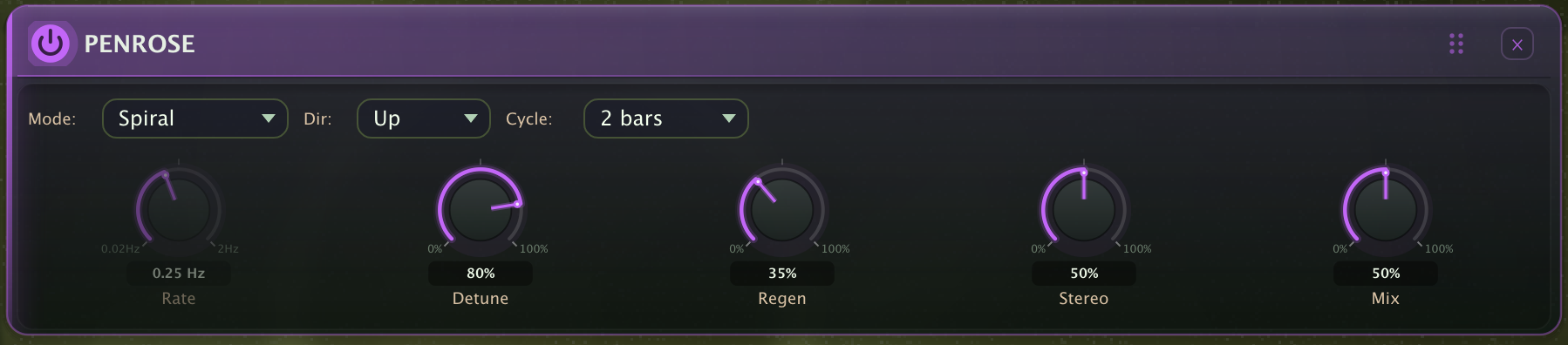
The three voice skeleton does not care what parameter it drives, so Laura's Penrose ships five modes that each point it somewhere different.
Spiral is the tape Doppler riser described above, and it is the one to reach for first. On a held supersaw chord it is a build with no ceiling.
Barber sweeps a stack of phase notches rather than pitch. This is the barber-pole phaser you have heard on records since the seventies, except that most of them turn around at the end and this one does not.
Risset moves the illusion into the time domain. Instead of three pitches an octave apart you get three rhythmic layers at exactly double and half each other's rate, crossfading the same way, so the pulse accelerates and accelerates and never arrives at fast. On a dark minor stab this is the drop that refuses to land. It needs one detail that pitch does not: the layers have to line their phases up at the handover, otherwise you get exactly the chattering that beating gave me in the pitch version.
Bode is the inharmonic one, named for the classic frequency shifter design. Metallic, mean, and the right answer when you want a siren rather than a lift.
Sweep puts a resonant peak on your signal and walks it up the spectrum forever, on top of the dry sound rather than replacing it. This is an endless filter build, and it means a bassline can play its own eight bar riser without you drawing a single automation point.
All five run backwards. Flipping the direction turns lift into descent, and endless descent is a distinctly different emotion, closer to dread than to tension. On a drone it is very hard to stop listening to.
Locking an infinity to the bar
An illusion that never ends still has to cooperate with an arrangement that does. This is the practical difference between a physics demo and a tool you use on a deadline.
The lap length in Penrose is a musical division, not a number of seconds. Set it to four bars and the effect completes a generation every four bars of the host tempo, which means the moment of maximum tension sits exactly where your break ends. Set it to sixteen for a long cinematic climb, or to one bar for something that feels frantic and mechanical. The illusion does not weaken when it is short, it just gets more urgent.
The stereo control offsets the right channel's position on the lap, so the two sides are climbing out of step with each other. At full offset the motion reads as circling the room rather than travelling straight up, which is a cheap and very effective way to make a mono build feel enormous.
Where it actually earns its place
The obvious home is psytrance and techno, where a build that never resolves is basically the genre's native tense. Park Spiral on a pad, sync it to four bars, hold the chord through the whole break, and pull a filter down over the top. There is nothing to draw and nothing to time.
It is just as useful in slower work. An endlessly descending phaser under strings is a scoring trick that costs one device. A resonant peak crawling up a sustained bass note gives a track forward motion during a section where nothing is happening harmonically. And on a rhythmic patch, the accelerating pulse gives you the classic ever tightening stutter without a single programmed step.
Penrose is the sixteenth device in Laura's effects rack and it is also in Laura FX, so it works on anything, not only on the synth. Five factory presets ship built around it, one per mode. If you want to hear a build with no ceiling, the demo is free and fully featured for thirty minutes a session, no account needed. Load Penrose Ascension, hold a chord, and see how long you can leave it before you feel the need to resolve it.
If you like reading about the awkward middle of building a synth, the piece on playing the edge of the Mandelbrot set covers a similar sort of problem from the oscillator end.
Keep reading
- Why your tempo synced LFO is in the wrong place · Set an LFO to one bar, print the loop, and it sounds right. Stop the transport, hit play again, and the same bar sounds different. The rate was never wrong. The position was.
- How to program a tape stop instead of drawing one · Every glitch fill you have printed was drawn by hand, once, for one drop, at one tempo. The alternative is to write time as a pattern and let the fill happen on the bar, every bar, without you being there.
- Playing the edge of the Mandelbrot set · Most of a fractal is quiet. The sound lives at the edge, and until now Laura mostly sampled past it. The new update pins the oscillator to the boundary, then adds the kind of modulation that knows how to walk along it.
Hear it for yourself. The demo is free and unrestricted for 30 minutes per session.