A polysynth by Lost Synapse · a one-person studio

Laura. Fractal oscillators, wavetables, and a mod matrix you wire by dragging.

A synth for sound designers who'd rather not learn another ecosystem. Four engines under one signal path, and one button to roll the dice when inspiration is late.

Free Substation, a techno pack of 27 club-ready patches. Get the pack →

Format · AU · VST3 · Standalone Platforms · macOS · Windows Installer · Signed & notarized License · One-time, lifetime Telemetry · None

One purchase. Lifetime updates. Every new build, free, forever.

Features at a glance New

Twice the LFOs now, and more room to route them.

Drag a source onto any knob.

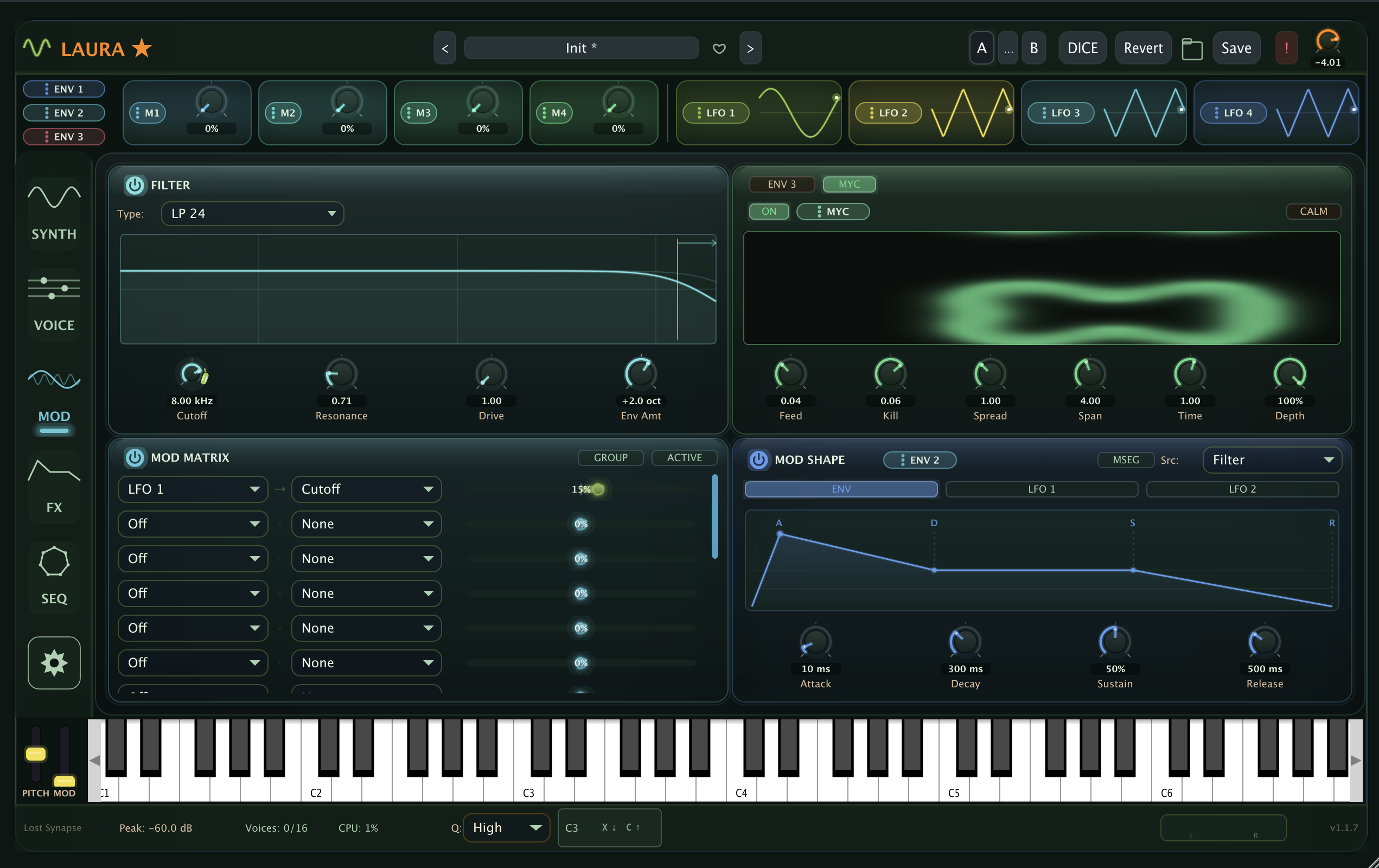
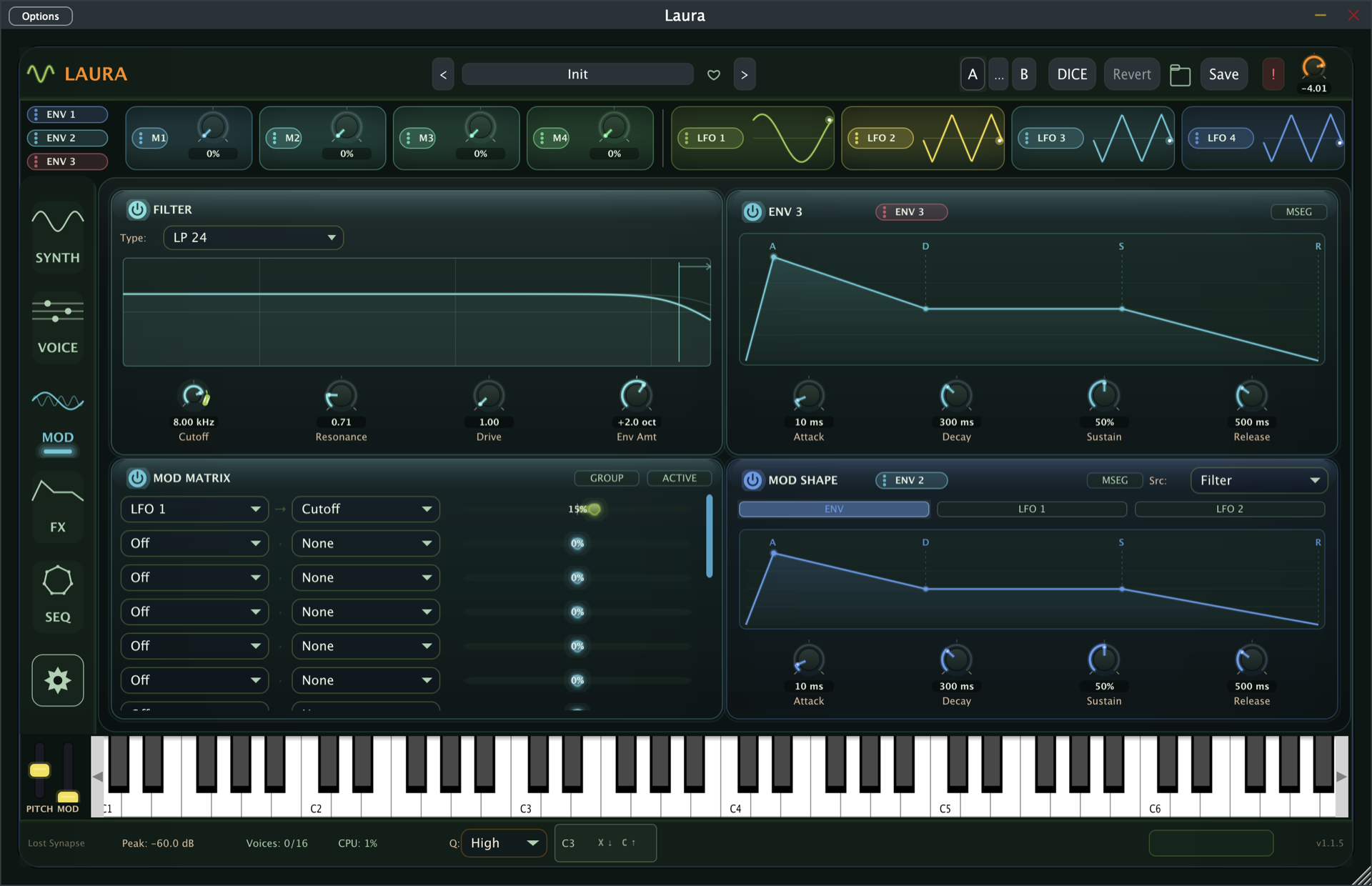
The mod matrix grew from four slots to sixteen, and it learned a faster way to fill them. Grab any source, whether an LFO, an envelope, a macro, or a sequencer output, and drop it on the knob you want it to move. The routing appears in the matrix, ready to play.

Every routing is colour matched to its source, so the depth slider and its arrow take on that source's colour. One look across the panel tells you what is driving what, even with a dozen routings live.

Laura's MOD panel: the filter, the ENV 3 envelope, the sixteen-slot mod matrix with source-coloured depth sliders, and the MSEG mod-shape editor.

Mycelium New

Voices that hear each other.

Mycelium is the first part of Laura where the voices in a chord affect each other. It's a small reaction-diffusion field, a living chemistry sitting behind the synth. Every note you play drops a little into it, at a spot set by pitch and by how hard you played, and the field spreads and grows slow shifting patterns. Each voice reads the field where it sits and turns what it finds into four modulation sources.

Because one note's chemistry spreads into the spot where another note is reading, the voices start to colour each other with nothing routed between them. Hold a tight chord and they grow together and the sound drifts around itself; play it wide and it stays clean. How you voice the chord is the control. Route Myc Value to cutoff, the gradients to pan or pitch, Flow to FM.

Laura's MOD panel with the MYC tab open: the Mycelium field shown as a glowing green bloom, with ON and CALM above it and the Feed, Kill, Spread, Span, Time, and Depth knobs below.

MPE New

Per-note pitch, pressure, and slide.

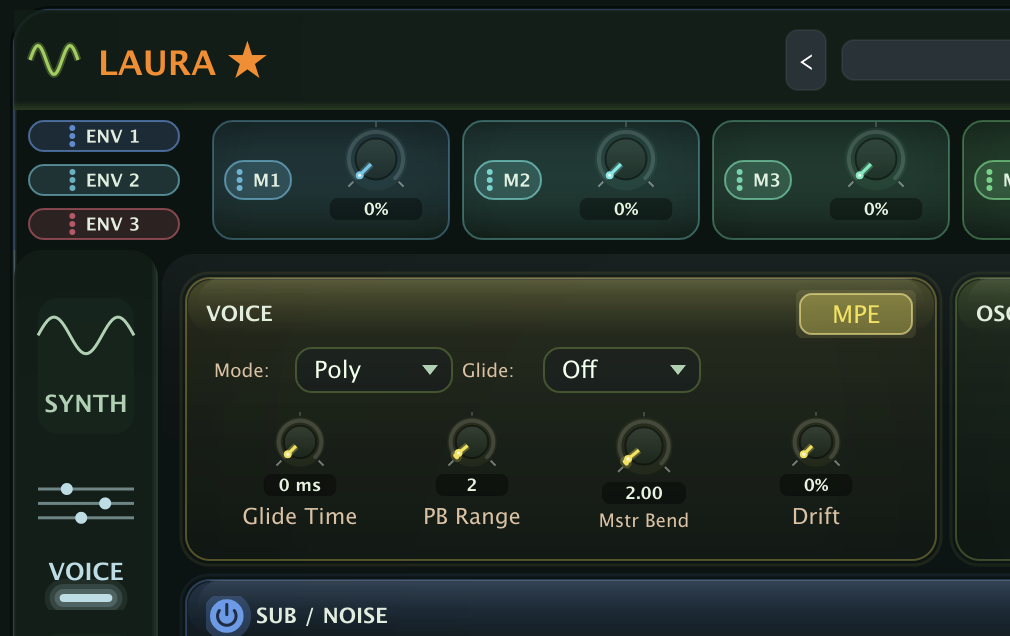
Play an MPE controller, a Seaboard, a LinnStrument, a Push, and Laura reads it per note. Each note's pitch bend, pressure, and slide belong to that note alone. Bend one note of a chord and the rest hold still. Lean on one and only it responds. Switch MPE on once, in the gear menu or on the VOICE panel, and it sticks across presets; if your controller announces its own setup when it connects, Laura just follows.

Pressure, Mod Wheel, and Timbre are also there as everyday modulation sources, so you can route aftertouch or the wheel to anything even on a plain keyboard. Per-note expression works on any polyphonic patch, which is nearly all of how you'd play MPE.

Laura's VOICE panel with the MPE button lit, the voice mode set to Poly, and the Glide Time, PB Range, Mstr Bend, and Drift knobs.

Fractal oscillators

Six escape time fractals. One playable map.

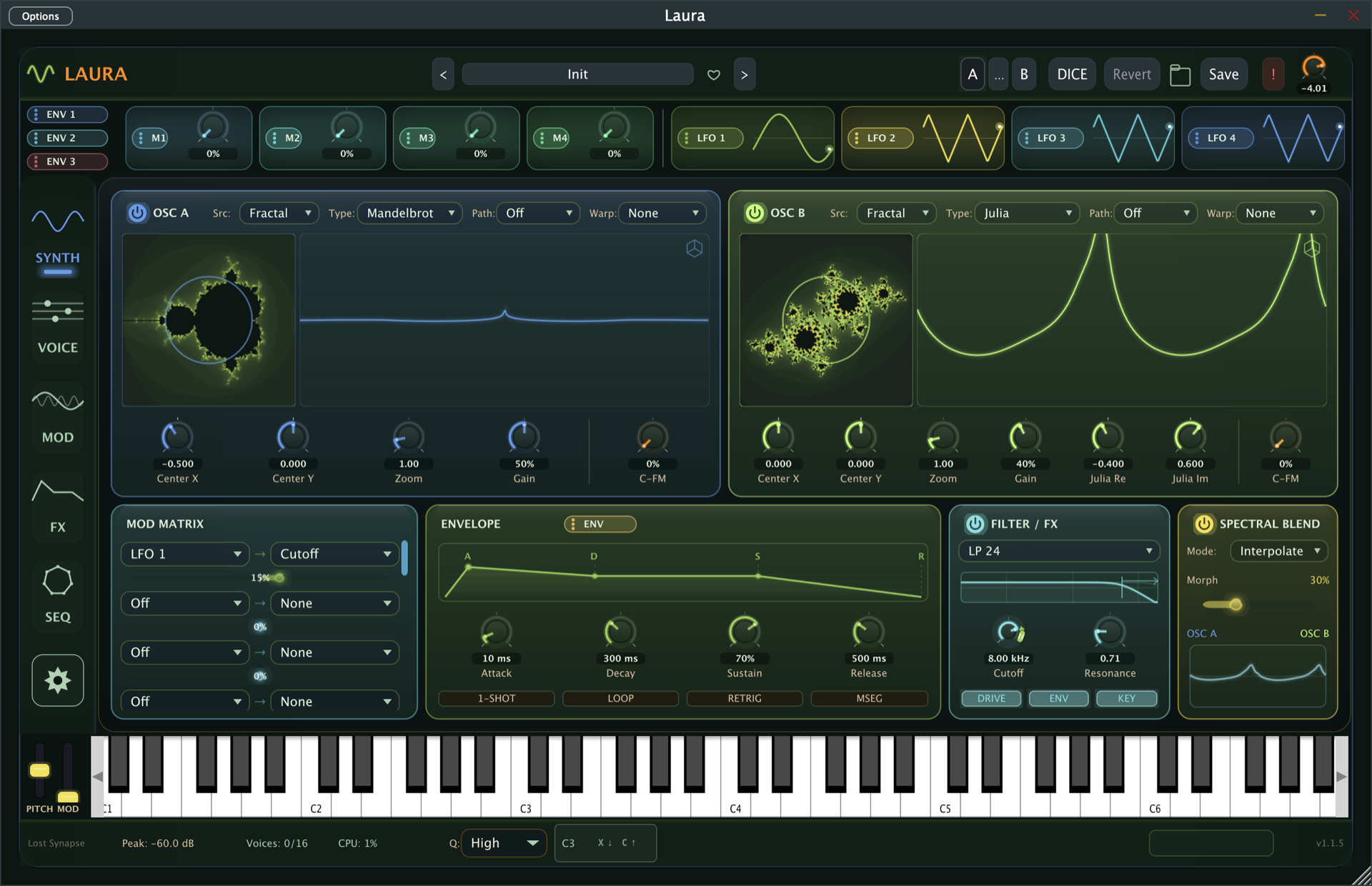
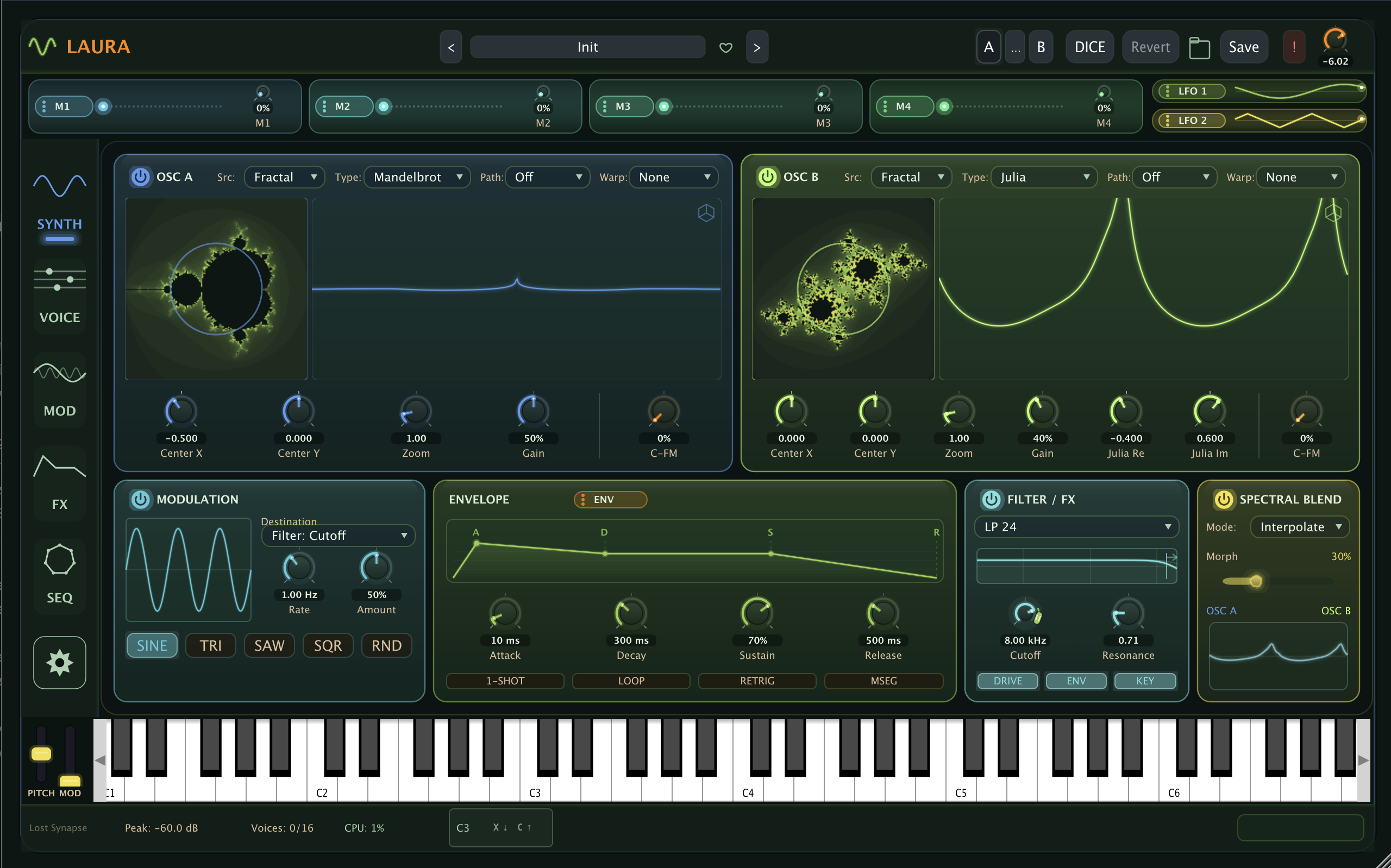
Laura's signature engine, and the one I'm proudest of. Each oscillator slot can switch to a fractal kernel: Mandelbrot, Julia, Burning Ship, Tricorn, Multibrot, or Newton. Every point on the canvas sounds different. Zoom in near the seahorse valley and you get smooth periodic textures. Drift toward a chaotic edge and the timbre turns rough and almost percussive.

The canvas in the oscillator card is interactive. Drag to move Center X and Center Y, scroll to zoom. All three coordinates are modulation destinations, so an LFO walks the timbre across the fractal forever. Pair two slow LFOs on incommensurate periods and the patch literally never repeats.

Laura's fractal oscillator canvas showing a wide view of the Mandelbrot set with a position indicator, current Center X / Center Y / Zoom readout, and a sample playhead trace across the slice.

Filter+ & Synapse

A filter that sings.

Laura's signature filter type is called Synapse. Two filter stages cascaded with a slight detune, always-on input warmth, six drive characters that shape the resonance itself, and a built-in Sing knob that folds the resonance peak into a harmonically-rich, almost vocal bloom.

Live response curve, A/B compare on the drive stage, audio-rate filter FM, per-voice cutoff jitter, stereo cutoff offset, resonance compensation. The character section of the synth, on its own full-width row.

The Filter+ panel with a live response curve, a Resonance knob, and two rows of character knobs including Sing, Stereo, Morph, Pivot, FM Amt, and Jitter.

Galaxy & Constellation New

Two sequencer modes built on physics.

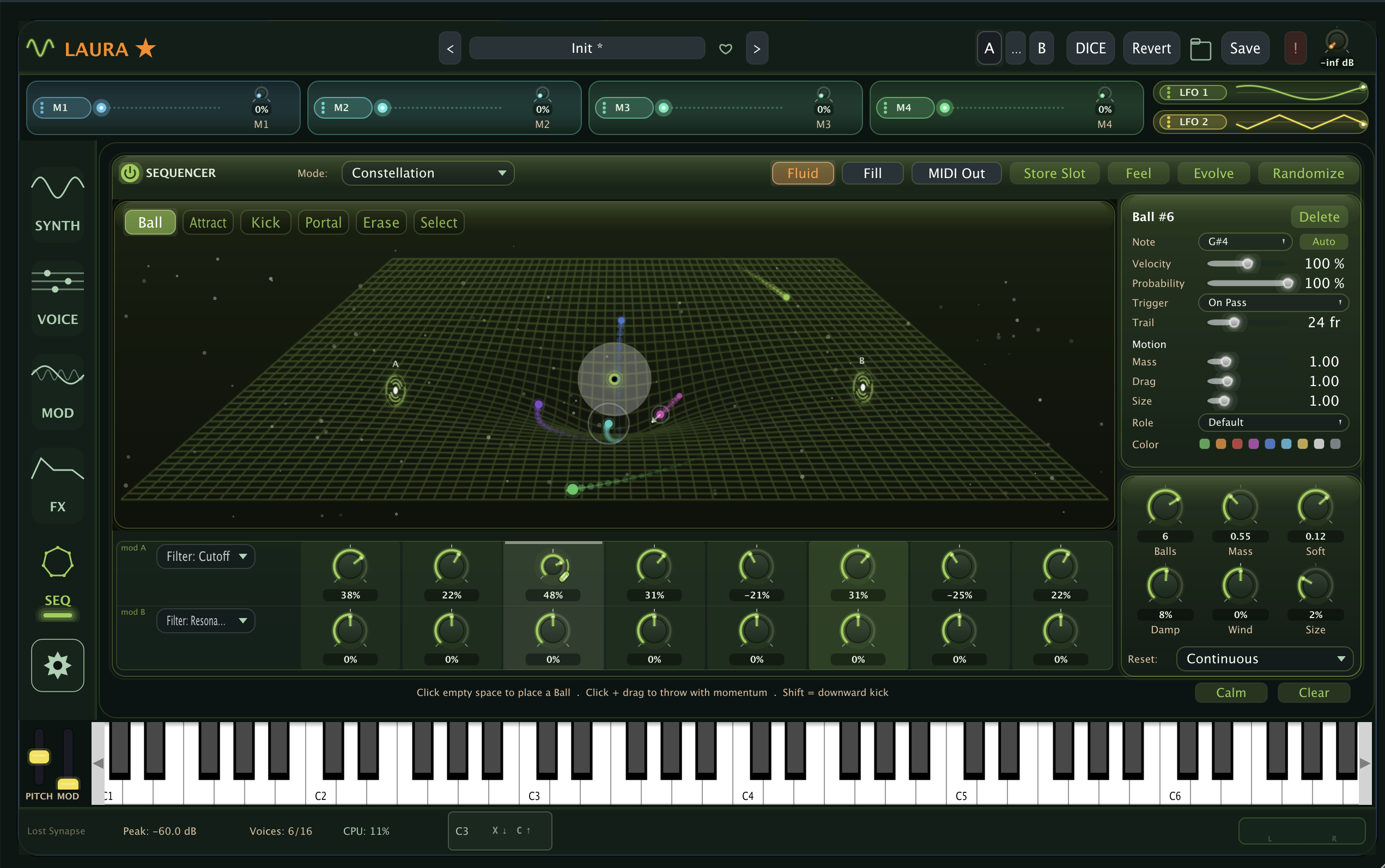
Two new modes on the sequencer's mode pill, alongside the original geometric step grid. Galaxy throws bouncing balls inside the shape's bounding region; nodes fire as the balls cross them, so density, speed, and damping become physics knobs rather than musical ones. The rhythm is loose, the timbral movement is emergent. Constellation places gravitational attractors inside the shape and the balls orbit them; the orbits couple, the system reshapes itself, and the firing pattern emerges from the math. The most experimental sequencer I've shipped, and the one most likely to produce a sequence you wouldn't have programmed.

Wormhole portals on both modes. Place up to two on the canvas, balls passing through one teleport to the other with velocity preserved. Per-ball notes, per-ball mass, per-ball roles (bass, lead, pluck), and a per-ball inspector. Same per-step lanes as the geometric mode (velocity, gate, probability, two assignable mod lanes), so patches feel familiar even when the rhythm isn't.

Laura's sequencer in Constellation mode showing a pentagon of orbital attractors, several balls in orbit at different mass scales, and a connected pair of wormhole portals on the canvas.

Mod Shape

Draw your own envelopes and LFOs.

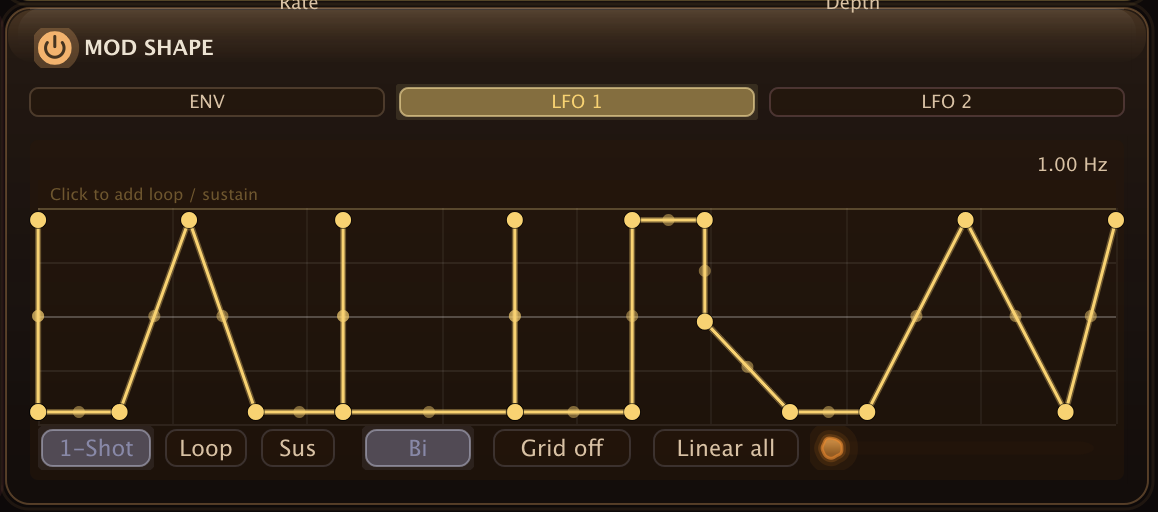
Every slot in Laura's modulation rack, all three envelopes and all four LFOs, has an MSEG mode. Toggle it on and the slot becomes a multi segment editor: drag points to shape the curve, drag segment midpoints to bend them, drop loop and sustain markers anywhere on the cycle, snap to a tempo grid if you want rhythm. The shape you draw is the shape the engine plays.

One shot, looping, and held sustain modes on every slot. Per segment tension with a dedicated step mode for square or staircase shapes. Tempo sync at 1/32 through 4 bars with dotted and triplet, or free run in Hz. Right click any point or segment for templates: saw, triangle, square, staircase, random, exponential. Each slot keeps its own undo stack, with Cmd+Z and Cmd+Shift+Z bound to the editor.

Laura's Mod Shape card showing the LFO 1 tab with a multi segment MSEG curve and the play mode pills (1-Shot, Loop, Sus), bipolar, grid, and Linear all controls along the bottom.

Wavetable editor

A full editor, not a preset picker.

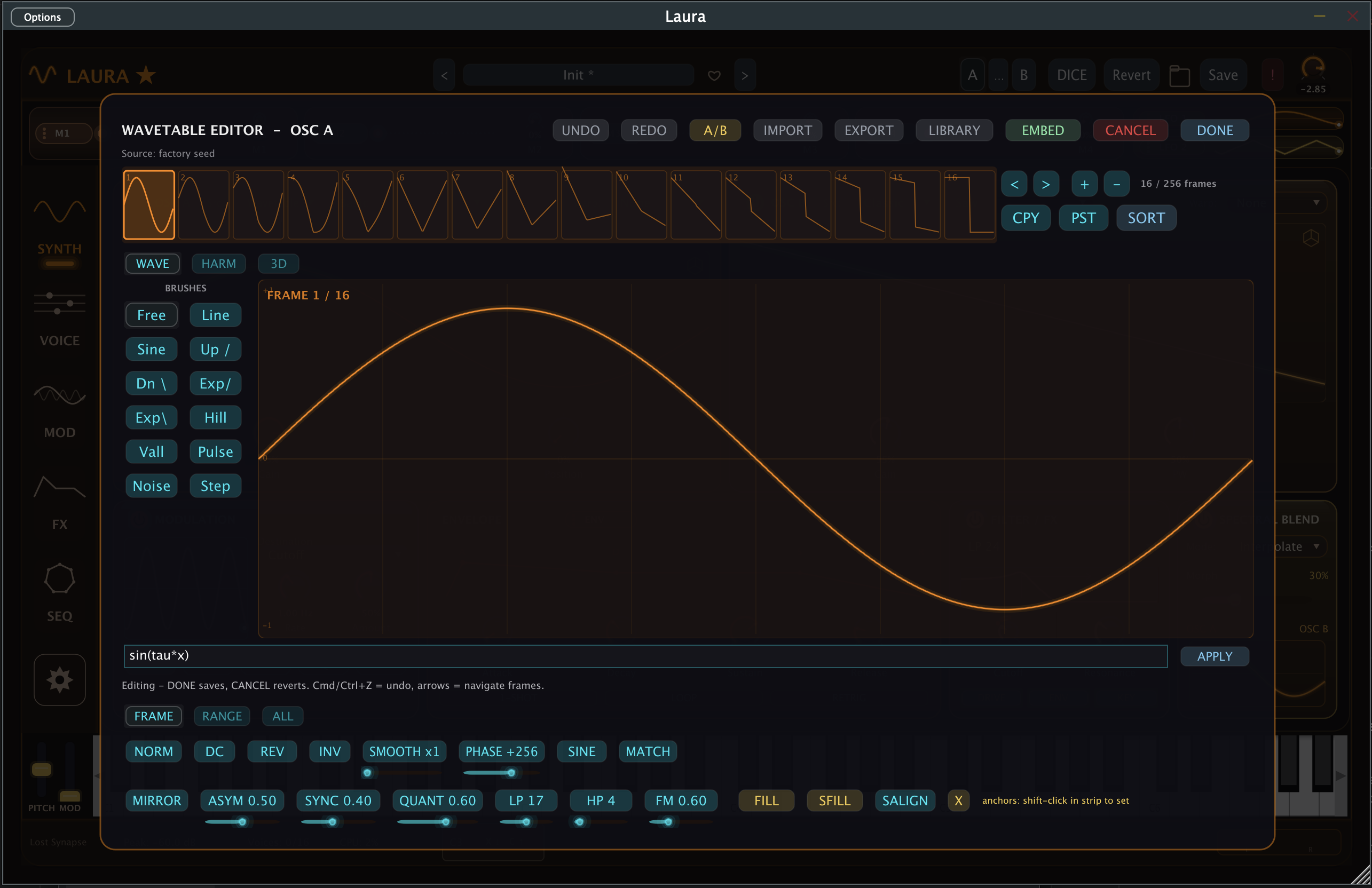
Draw frames by hand, import a WAV, or type a formula like sin(tau*x) and watch it land. Brushes for sine, pulse, noise, hills, and step shapes. Per-frame, per-range, or per-table operators. NORM, SMOOTH, PHASE, SYNC, QUANT, LP, HP, FM, MIRROR, ASYM, SALIGN. Audition live, A/B against the original, embed the table in the preset so the patch travels with you.

Up to 256 frames. Real-time edits, clickless. Built in, no extra charge.

Laura's wavetable editor: 16 of 256 frames, formula box, brushes panel, per-frame operators.

FX rack

Fifteen modules. One chain. Reorder at will.

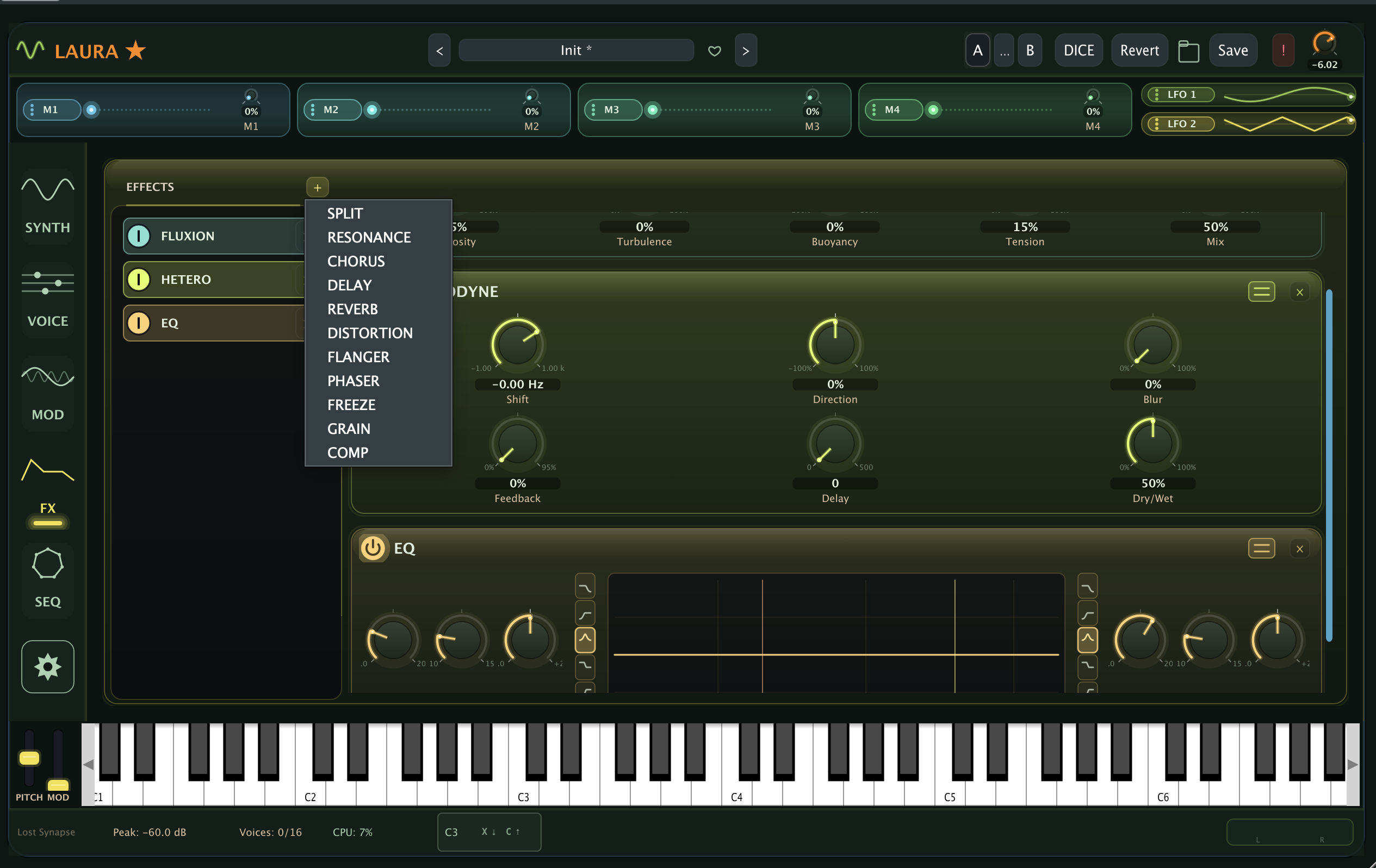
Splitter, Resonance, Chorus, Delay, Reverb, Distortion, EQ, Flanger, Phaser, Freeze, Hetero, Grain, Fluxion, Compressor. Drag any module up or down the rack to reorder. Click the power icon on a module to bypass it without removing. Right click any knob to wire it into the modulation matrix.

Splitter tags the signal with two or three LR4-flat bands for per-band routing. The convolution reverb takes your own IRs and embeds them in the preset. The character compressor has Bloom, Drift, Pump, and Spectral character sections on the side. Chain order matters: EQ before reverb is a tone control, EQ after reverb shapes the tail. Distortion before delay sounds dirty, distortion after delay sounds like a pedalboard.

Laura's FX rack panel showing a chain of effect modules in series with bypass and remove controls, alongside the add-module picker that lists all fifteen FX types.

What's inside

The parts you'll actually reach for.

Hover a title to read more, or tap on mobile.

Four engines, drawn together

Wavetable, FM, classic analog (saw, square, triangle, sine, pulse), and fractal oscillators (Mandelbrot, Julia, Burning Ship, Tricorn, Multibrot, Newton), paired across two oscillator slots with full per-voice routing. Switch engines without losing your patch.

Mycelium: voices that couple New

A shared reaction-diffusion field behind the synth, the first place in Laura where the voices in a chord affect each other. Notes feed it and read it; one note's chemistry spreads into where another is reading, so a tight chord grows into itself and a wide one stays clean. Four per-voice sources (Value, two gradients, and Flow) carry it into the rest of the patch.

MPE, per note New

Any MPE controller, a Seaboard, a LinnStrument, a Push, or anything else that sends MPE. Every note carries its own pitch bend, pressure, and slide, each routed to the right voice. Pressure, Mod Wheel, and Timbre are modulation sources on any keyboard. Switch MPE on in the gear menu or on the VOICE panel; it sticks across presets and follows your controller's own setup. Per note on polyphonic patches.

Preset Browser with search, tags, and categories New

Full-bleed browser with a category sidebar, search across name and tag, and 14 character-axis tag chips (acid, ambient, bright, dark, evolving, gritty, lush, vintage, warm and more). Chips that have no matches grey out and slide right so the useful ones are always at hand. All 277 factory presets get tags at startup.

Sequencer beyond the grid New

Four modes on one engine. Geometric: notes ride a 2D shape with per-step velocity, gate, probability, and two assignable mod lanes. Galaxy: bouncing-ball physics fires nodes as balls cross them. Constellation: orbital attractors with gravitational coupling, plus wormhole portals you place on the canvas. Arp: hold a chord and the keys become a tempo-synced arpeggio, with a generative Drift order that walks through the chord on its own. Conditional triggers, fractal sub-step nodes, four pattern slots with crossfade morph, eight feel presets with per-click variation.

Character Compressor New

Classic dynamics stage on the left, four optional character sections stacked on the right: Bloom (parallel resonant band that breathes with the gain reduction), Drift (smooth random walk on threshold and timing), Pump (internal sidechain LFO, free Hz or beat-synced), Spectral (2-band or 3-band LR4 split). Harmonics saturator wakes up when the compressor pumps.

Plays without a DAW New

Laura ships a fully featured Standalone app alongside the AU and VST3. Open it from /Applications on macOS or Program Files on Windows, pick an audio device and a MIDI input, and play. Same engines, same FX rack, same sequencer, same presets, just running on its own.

Draw your own envelopes and LFOs

Every modulator slot in Laura, all three envelopes and all four LFOs, can flip to a multi segment user drawn curve. Per segment tension, step nodes, loop and sustain markers, tempo sync. The shape you draw is the shape that plays.

Synapse: a filter that sings New

Laura's signature filter type with always-on warmth, drive-mode-shaped resonance, and a Sing knob that folds the resonance peak into a vocal bloom. Six drive characters give it six personalities. I haven't heard another filter quite like it.

Filter+ with a live response curve

Pre-filter drive (six characters), series HP, A/B compare on the drive stage, resonance compensation, audio-rate filter FM, per-voice cutoff jitter, stereo cutoff offset, and a live curve display. Enough controls here to build a patch out of the filter alone.

A fifteen-module FX rack

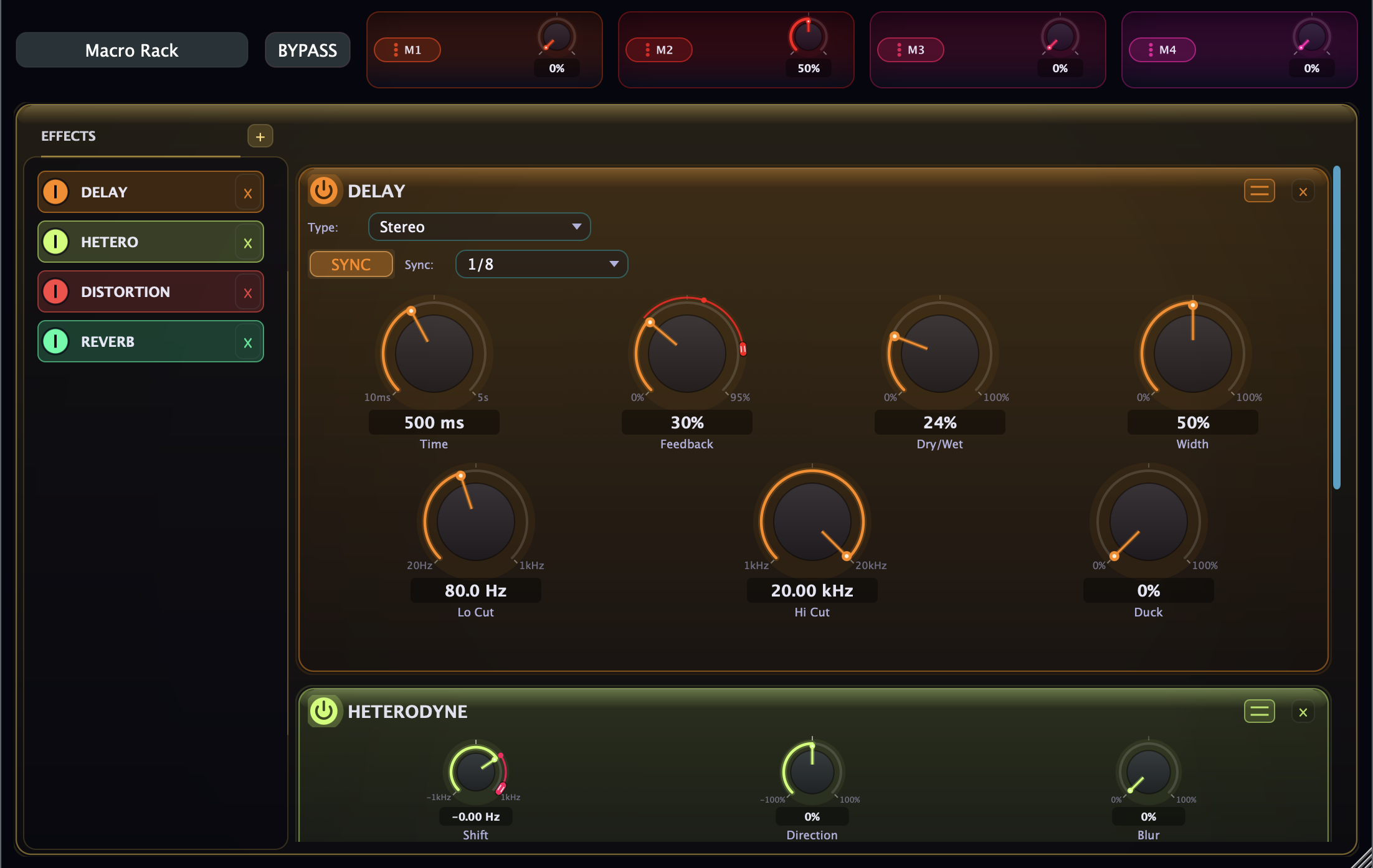
Chorus, delay, distortion, phaser, flanger, and ten more. Sensible amounts by default, more on tap when you want it. The DICE button rolls a curated rack alongside the patch, so a sketch is one click away.

Convolution reverb, with your IRs

Drop your own impulse responses. Embed them in the preset. Take them with you. No third-party engine to license.

277 factory presets, loudness-matched

Switching presets used to swing perceived loudness by 16 LU between a sub patch and a resonant lead. Every factory preset is now offline-rendered, measured against -20 LUFS-I, and master-gain calibrated to land within a half-LU window. Browsing feels like browsing, not riding a fader.

Signed installers, both platforms New

macOS .pkg is signed with my Apple Developer ID and notarized by Apple. Windows VST3 and Standalone are signed via Microsoft Trusted Signing. macOS opens the installer without a Gatekeeper warning, Windows SmartScreen doesn't flag it. No right-click trick on first launch.

Lifetime license, no strings

Buy it once. No subscription, no telemetry, no cloud. The license verifies offline, so Laura runs fine on a machine that never goes online. Your saves are your saves.
Run it on your own material. The demo is free and unrestricted for 30 minutes per session.

What's new

Recent updates.

New features and fixes ship when they're ready. Below is what just landed.

    • A custom theme. Open the cog menu, pick Customize colours, and choose your four accents from a colour picker. The panels, the LFO badges, the knob rings, and the background all recolour as you go. The dark backgrounds stay put so it never loses contrast, and your palette saves with the rest of your settings.
    • The menus match the rest of the synth now. The cog menu and the add-effect list used to fall back to a plain grey system menu; they're dark glass like everything else, and the theme picker shows each theme's colours as little swatches so you can see a palette before you pick it.
    • The FX rack isn't a blank panel on a fresh patch anymore. It opens with one-click chips for the effects you reach for first, so the first one is a click away.
    • The preset browser reads more easily. Rows light up under the pointer, and the category sits in a coloured tag next to the name instead of off at the far edge.
    • Smaller things throughout. The nav icons respond when you touch them, tooltips no longer sit on top of the value you're reading, the voice page lost an awkward gap, and a short welcome note points new players at the basics on first launch.
    • Nothing about the sound changed. Your patches, your packs, and your license carry over exactly as they were.

    Read the full notes →

See all updates →

New. Substation is the first free preset pack: 27 peak-time techno patches for Laura, all at the same level so you can play through them without rebalancing.

Why Laura exists

I started making music in 2016 and went through a considerable library of synths. They all worked. None of them combined the blocks the way I would assemble them by hand, and the fractal oscillator I wanted didn't exist in any of them. So I started writing my own. Laura is the result.

First impressions

I demoed your synth for my aunt, I had told her it uses fractal math and she seemed intrigued. Once I showed her how it worked she was baffled by it and amazed.

Frequently asked

Common questions.

What formats does Laura support?

Laura ships as AU, VST3, and Standalone on macOS and Windows. One $69 purchase gets you all three formats on both platforms. The Standalone runs on its own, so you can play Laura without a DAW open.

Will macOS show an unidentified developer warning?

No. As of v1.1.4, the macOS installer is a signed and notarized .pkg with my Apple Developer ID, and the AU, VST3, and Standalone bundles inside are individually signed with Hardened Runtime. macOS opens the installer normally. Windows builds are signed via Microsoft Trusted Signing, so SmartScreen doesn't flag them either.

Can I run Laura without a DAW?

Yes. The Standalone app installs to /Applications on macOS and to Program Files on Windows. Launch it like any other application, pick your audio device and MIDI input from its menu, and play. It's the same Laura you load as a plugin, in a window of its own.

Is Laura a subscription?

No. Laura is a one-time purchase. Your license is lifetime and includes free updates, new FX modules, and preset packs for as long as the product exists.

Does Laura have a free demo?

Yes. The demo is fully featured for 30 minutes per session, then plays a quiet noise burst every 30 seconds until you activate. You can download it without an account.

Does Laura phone home or collect telemetry?

No. There is no telemetry, and the license verifies offline, so Laura runs fine on a machine that never touches the internet.

How thoroughly is Laura tested?

Laura passes pluginval at strictness 10, the highest level of Tracktion's open-source plug-in validator. The suite covers state save and restore, parameter automation, parameter fuzzing, audio-thread safety, and bus configuration across sample rates from 44.1 to 96 kHz and buffer sizes from 64 to 1024 samples. I run it as part of every release build before I ship, with a separate set of regression tests to make sure Laura holds up under extended use.

Can I use Laura on multiple computers?

Yes. The license is portable. Install Laura on as many of your own machines as you need and drop the same .lic file onto each.

What synthesis engines are inside Laura?

Four engines under one signal path: wavetable with a full built-in editor, frequency modulation (FM) with two operators, classic analog-style oscillators (saw, square, triangle, sine, pulse), and fractal oscillators (Mandelbrot, Julia, Burning Ship, Tricorn, Multibrot, and Newton).

Does Laura include a wavetable editor?

Yes. The built-in editor lets you draw frames by hand, import WAV files, or type a formula like sin(tau*x). It supports up to 256 frames, with brushes, per-frame operators, and live preview.

Can I get a refund?

Yes. There is a 14-day refund policy. Reply to the license email and the refund is processed without a form.

Launch pricing

A fair price for an instrument I'm still adding to.

Laura is under active development. Your purchase comes with free updates for life. New FX modules, preset packs, DSP refinements, and design polish all ship in every build. You're not paying again later.

Limited time
$149 $69

USD · one-time · lifetime license

  • Lifetime license to Laura. Never expires.
  • Lifetime free updates. New FX modules, preset packs, and DSP refinements as they ship.
  • Design that keeps maturing. Every build sands an edge off the GUI.
  • All three formats: AU, VST3, and Standalone.
  • macOS and Windows in one purchase.
  • License hits your inbox in minutes.
  • No subscription. You pay once.
  • License verifies offline. Works fine with no internet at all.
  • No telemetry.
  • 14-day refund. Reply to the email, no forms.