The short version
It depends entirely on where you look. The Mandelbrot set holds thousands of different sounds. Move to a calm region and you get a smooth, rounded tone with only a few harmonics, close to a soft analog wave. Move toward the jagged boundary and the same oscillator turns bright, buzzing, and full of detail. Push into a chaotic filament and it breaks up into something rough and almost percussive.
So the real answer is another question: which part of it do you want to hear? That is exactly what makes the thing worth building an instrument around.
First, what the Mandelbrot set actually is
You have almost certainly seen the picture: a black bulbous shape ringed by an infinitely detailed, flame-like edge. It comes from a piece of arithmetic much simpler than the image suggests.
Take a point on a flat plane. Feed it through a short loop that squares a running value and adds the original point back in, over and over. For some points the running value stays small forever. Those points are inside the set, and they get drawn black. For others the value runs away toward infinity. Those are outside. The colours along the edge just record how quickly each outside point escaped: a few steps for the bright bands, many steps for the darker ones hugging the boundary.
That escape count is the part that matters for sound. It gives every point on the plane a number, and a number is something an oscillator can use.
Turning a picture into a wave
An oscillator needs one cycle of a waveform, which is a row of numbers that rise and fall between two limits. A wavetable synth stores those rows as fixed frames and scrubs between them. A fractal oscillator generates the row on the fly.
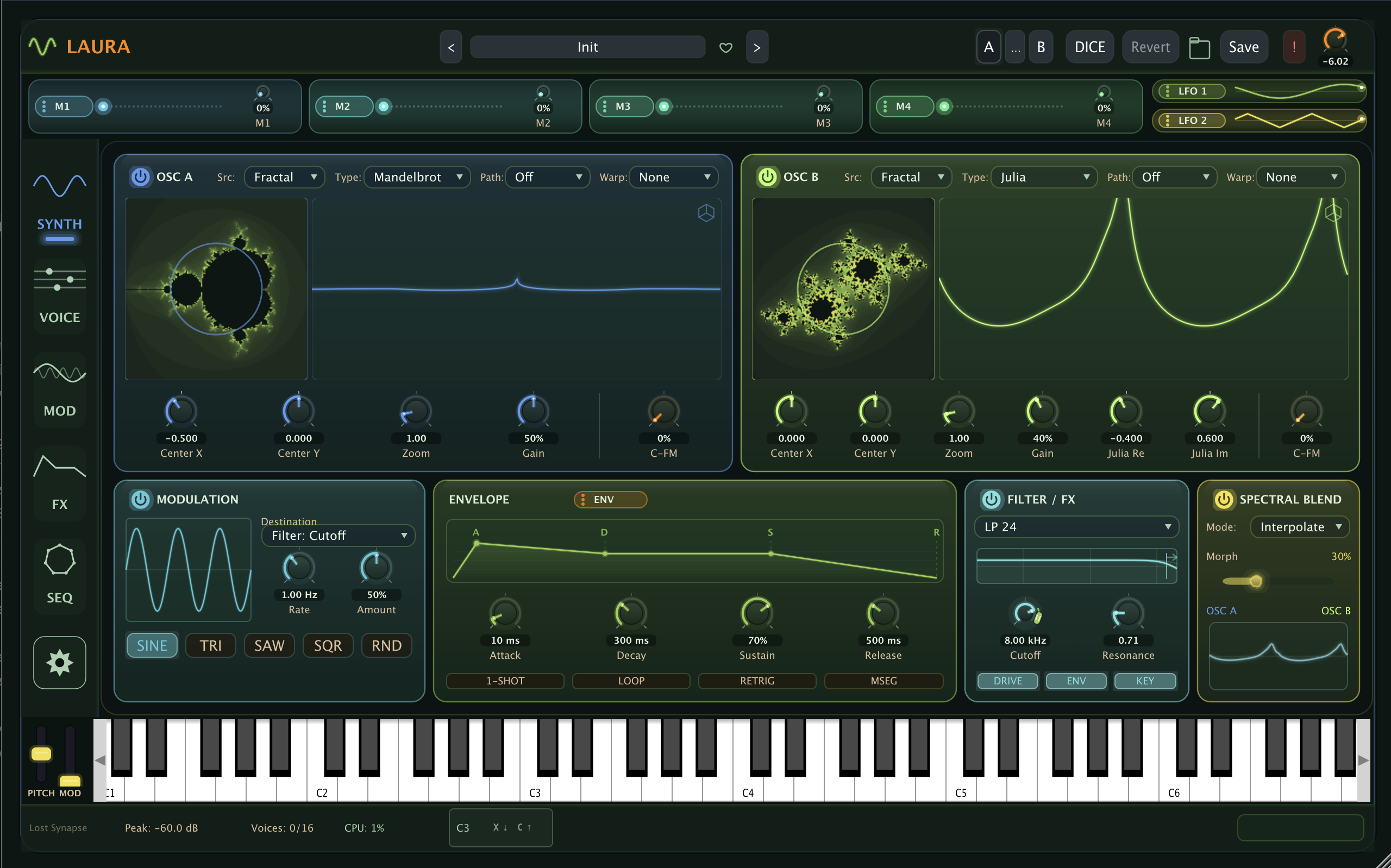
Here is the trick Laura uses. Draw a straight line across the set at some position and zoom level. Walk along that line and read the escape value at each step. That row of values becomes one cycle of the wave. Where the line crosses smooth territory, the row is smooth and the tone is mellow. Where it clips through the boundary, the row is full of sharp swings, and the tone is bright and complex.
Move the line and you get a different row, which means a different timbre. Because the boundary holds infinite detail, you never run out of new places to read from.
So, what does it sound like?
Deep inside one of the large bulbs, the reading is calm. Few harmonics, a soft body, the kind of tone you would reach for on a pad or a sub.
Slide out toward the seahorse valley, the curl where the main body meets the smaller one, and the wave gains harmonics fast. It goes reedy, then brassy, then glassy as you near the edge. This is the region I keep coming back to, because small moves make big, musical changes in the tone.
Cross one of the thin filaments that spiral off the boundary and the oscillator turns raw. The harmonics stop sitting on a tidy series and the result reads as gritty, closer to noise than to a note. Used on purpose, that is a texture, not a fault.
Why it holds up musically
A still image of a fractal is a curiosity. The reason it earns a place in a synth is that you can move through it while a note is still ringing.
In Laura the three coordinates that place the reading line, its horizontal position, its vertical position, and the zoom, are all modulation destinations. Point an envelope at the zoom and a note blooms open as it sustains. Point a slow LFO at the position and the timbre drifts on its own. Use two slow LFOs on rates that never quite line up and the sound never exactly repeats, because you are not cycling through a handful of stored frames, you are wandering a continuous space with no seams.
That is the part a wavetable cannot do. Between two wavetable frames there is a blend. Between two points on a fractal there is more fractal.
The other five kernels
The Mandelbrot set is the famous one, but it is a single map out of six. Each oscillator slot in Laura can switch its kernel to Julia, Burning Ship, Tricorn, Multibrot, or Newton, and each one has its own character to read from.
Julia sets are relatives of the Mandelbrot with a cleaner, more symmetric feel. Burning Ship is all hard angles and spikes, so it reads harsher. Newton comes from a different kind of equation and tends to land on more ordered, tonal shapes. Same idea in every case: a plane full of numbers, a line drawn across it, a wave read off the line.
Hear it for yourself
Text can only get so close to a sound. The honest way to answer what a Mandelbrot set sounds like is to grab the reading point, drag it around, and listen to the tone change under your hand.
You can do exactly that in Laura's fractal oscillators. The demo is free and fully featured for thirty minutes a session, with no account needed. Load a fractal oscillator, play a note, and move the canvas. That is the whole answer, and it is a better one than I can write down.
Keep reading
- Why your tempo synced LFO is in the wrong place · Set an LFO to one bar, print the loop, and it sounds right. Stop the transport, hit play again, and the same bar sounds different. The rate was never wrong. The position was.
- How to program a tape stop instead of drawing one · Every glitch fill you have printed was drawn by hand, once, for one drop, at one tempo. The alternative is to write time as a pattern and let the fill happen on the bar, every bar, without you being there.
- How to build a riser that never ends · Every riser you have printed ends somewhere. It runs out of top, or it loops and you hear the seam. A longer sweep will not fix it. What does is an illusion that has been sitting in the psychoacoustics literature since 1964.
Hear it for yourself. The demo is free and unrestricted for 30 minutes per session.