Highlights
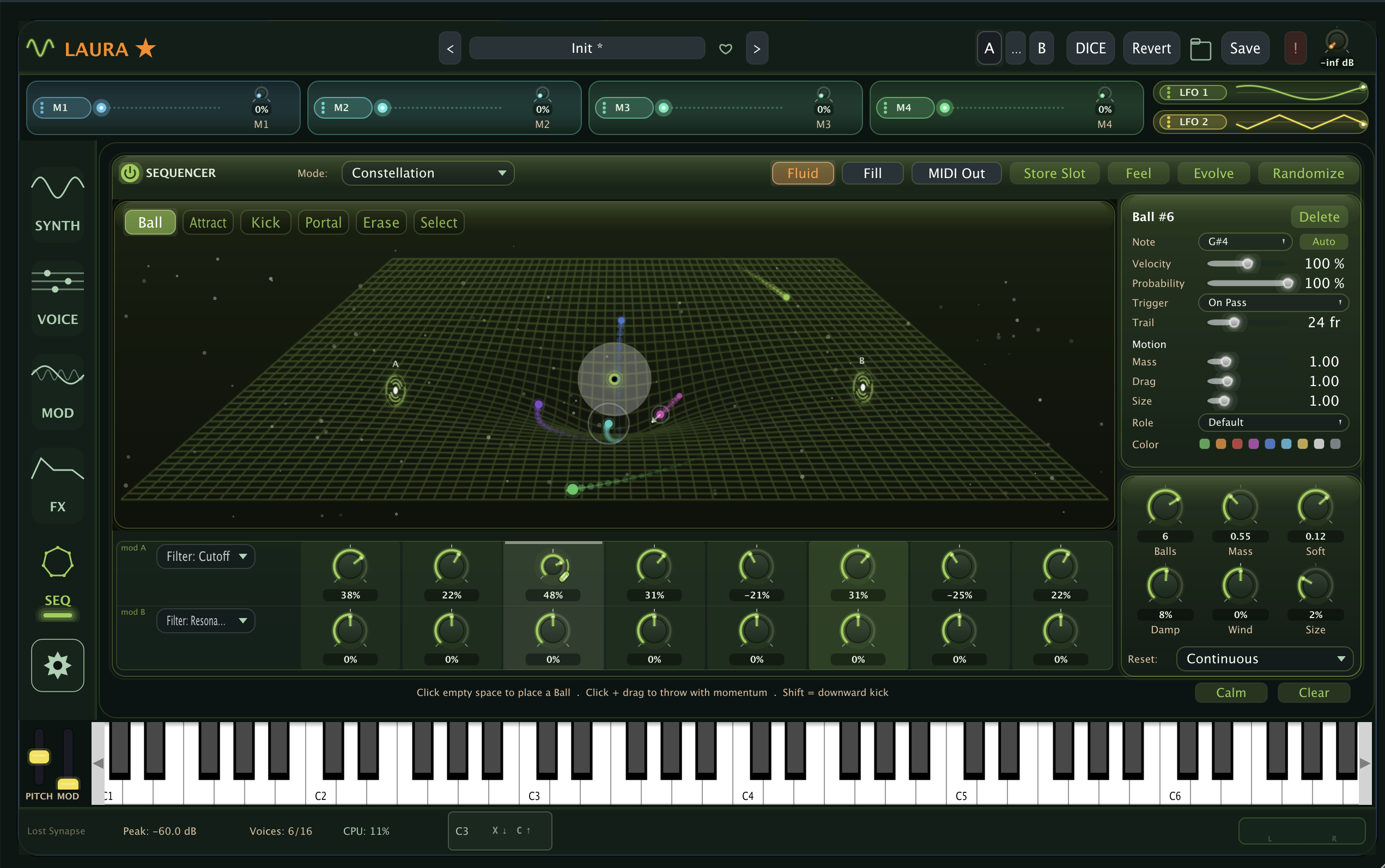
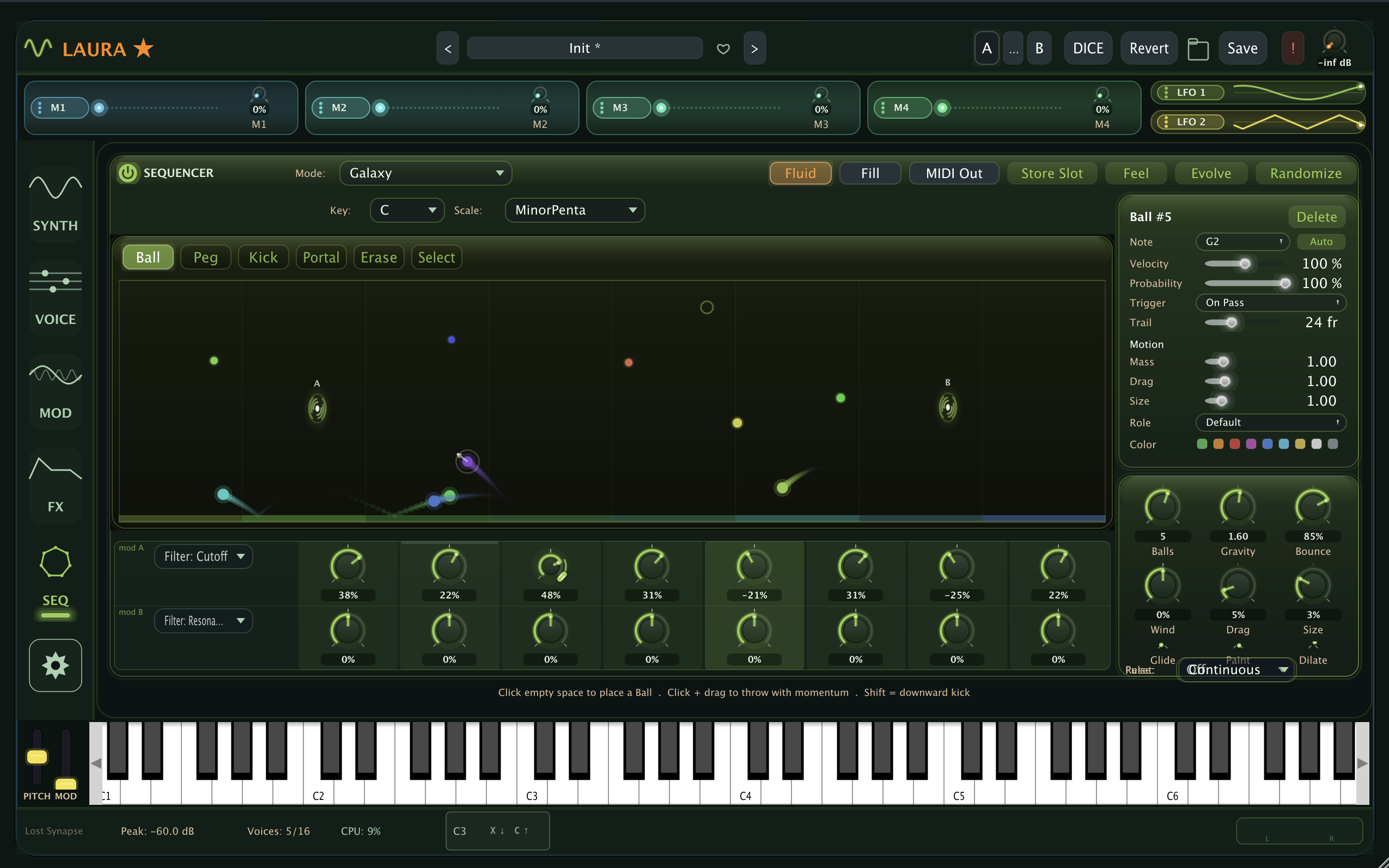
- Two new sequencer modes: Galaxy and Constellation. Galaxy is bouncing balls inside the shape's bounding region; nodes fire as balls cross them, so density, speed, and damping become physics knobs rather than musical knobs, and the result is a rhythmically loose evolving pattern. Constellation is orbital attractors with gravitational coupling; the firing pattern emerges from the physics. The most experimental sequencer behaviour I've shipped, and the one most likely to produce sequences you wouldn't have programmed.
- Wormhole portals in the sequencer. Place up to two portals on the Galaxy or Constellation canvas (Portal tool, click empty space). Balls crossing one portal teleport to the other with velocity preserved and a short cooldown so the destination doesn't yank them straight back. Portals persist through preset save and load. Five new factory presets exercise the mechanic: Stellar Bloom, Music Box Constellation, Dub Wormhole, Lumen Cascade, plus First Light as a brand-reveal pad.
- Signed and notarized macOS distribution. Every bundle (Laura.component, Laura.vst3, Laura.app) is signed with my Apple Developer ID, Hardened Runtime is on, and the .pkg carries a stapled notarization ticket so Gatekeeper verifies it offline. macOS opens the installer without a warning.
- Standalone app shipping. Laura.app installs to /Applications on macOS and runs as a regular application. Same engines, same FX rack, same sequencer, same presets. Useful for sketching without a DAW open or for running Laura live in front of an audio interface.
- One-click .pkg installer. Double-click Laura-1.1.4.pkg and walk through it. Customize step lets you tick or untick each of the three formats. Laura.component goes to /Library/Audio/Plug-Ins/Components, Laura.vst3 to /Library/Audio/Plug-Ins/VST3, Laura.app to /Applications.
- Drag-install still supported. The download zip's macOS folder still contains the loose signed bundles for anyone who prefers managing their own plugin folders. Windows continues to ship as the signed VST3 we've had since v1.1.2.
- Click-free voicing. Cold notes now start each oscillator on its wave's natural zero crossing (Sine 0, Tri 0.25, Saw 0.5, Square 0) so the filter sees a smooth ramp instead of an impulse, killing the attack click that fast-attack patches like Sub Anchor used to show. Mono retrigger keeps oscillator phase continuous so 32nd-note runs no longer leave a gap between notes. Legato retrigger keeps the running phase entirely so glides are audible without a wave restart.
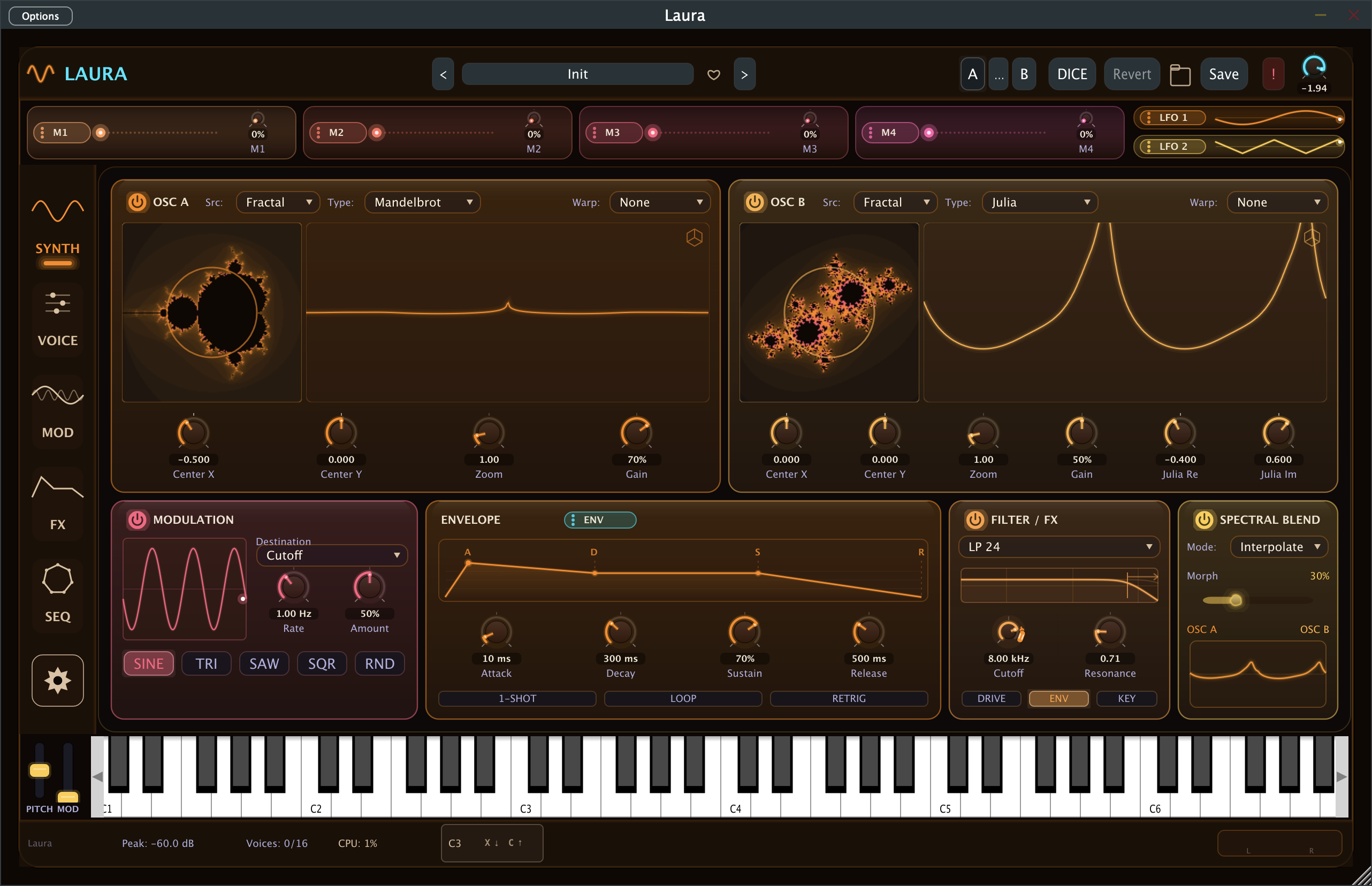
- New osc_phaseRandom switch on the VOICE tab restores the legacy free-running phase for patches that want the analog feel; per-oscillator phase offsets (oscA_phase, oscB_phase) are exposed as knobs and a Random button.
- Pluginval at strictness 10 baseline. Laura now clears Tracktion's pluginval at the strictest setting across sample rates 44.1 / 48 / 96 kHz and block sizes 64 / 128 / 256 / 512 / 1024. Coverage spans state save and restore, parameter automation and fuzzing, audio-thread safety, and bus configuration. Listed as a reliability bullet on the FAQ.
- Post-pluginval hardening: setStateInformation now calls engine.reset() so loading a preset wipes reverb tails, predelay, comb feedback, resonance net, granular grains, spectral freeze, and Fluxion state (the user's panic button is honest again); Fluxion peak-hoover stability cap closes the Honey Lake runaway analytically; NaN recovery now covers every persistent array (mag, out, phase, turbField) since coupled IIRs preserve NaN through bounded inputs; dry-delay bypass crossfade masks the inter-source phase seam when Spectral Blend automation sweeps the bypass threshold; cold-startNote warmup counter pins the smoother at live for HOP*3 samples so the just-cleared ring doesn't emit silence into the attack.
- All 271 factory presets re-normalised to -18 LUFS-I. Switching presets used to vary up to 16 LU in perceived loudness (Sub Anchor at -21, Acid Cutter at -5); they now sit within a half-LU window.
- TemporalSmearer gets a smear_width parameter (0..1, default 0.5 = the legacy 11 ms exactly, so saved presets sound bit-identical). 51 plucky factory presets ship at smear_width=0.2 (~4.4 ms Haas) for noticeably smoother stereo on dense sequenced playback.
- Music Box: attack 1 ms to 6 ms, filter env amount 1.2 to 0.7. The original was reading as clickiness on sequenced 16ths; the new defaults keep the plinky character on melodic use without the click.
- Preset save now refuses to write a user preset whose name collides with a factory preset (loadByName resolved factories first, so a user-saved 'Sub Anchor' would become unreachable through the normal load path). Dialog shows a 'Name reserved' alert and offers the rename in place.
- New 'Wubba Lubba' theme: portal-green SEQ panel, Meeseeks cyan MOD, Morty yellow FX, jeans-blue SYNTH, Rick pale-blue VOICE. Macro pills sweep from jeans-blue toward portal-green so M1 to M4 track the show palette. Theme switches now retint every cached UI accent live, no plugin reload needed.
Details
Two big pieces land together. A new sequencer behaviour that nobody asked for and that turned out to be the part of Laura I want to play with the most, and the install pipeline I should have shipped a year ago. Plus a long polish pass underneath them.
Galaxy and Constellation are two new modes on the sequencer's mode pill, next to the original Geometric mode. Galaxy throws bouncing balls inside the shape's bounding region; balls cross the existing nodes and fire them, but the velocity and density and damping are physics parameters rather than musical ones, so the rhythm is loose and the timbral movement is emergent rather than programmed. Constellation places gravitational attractors inside the shape and the balls orbit them; the orbits couple, the system reshapes itself, and the firing pattern comes out of the math. Both modes carry the same per-step lanes (velocity, gate, probability, Mod A, Mod B) that the geometric mode does, so the patches feel familiar even when the rhythm is unfamiliar. Per-ball notes, per-ball mass, per-ball roles (bass, lead, pluck), and a per-ball inspector for fine-tuning.
On top of that, the Portal tool. Click empty space on the canvas to place a wormhole; place a second one to connect them. Balls passing through one teleport to the other, velocity preserved, with a brief per-ball cooldown so they don't get yanked back the moment they arrive. Under the new Wubba Lubba theme the portals render in portal-green and look like Rick and Morty portals, which was an accident I decided to keep. Five new factory presets ship in the LOST SYNAPSE category to exercise the new mechanics: Stellar Bloom (ambient drone pad with a four-attractor diamond in A minor pentatonic), Music Box Constellation (D major spiral with pluck-role balls), Dub Wormhole (the wormhole the theme is named after), Lumen Cascade (D Dorian pentagon of attractors with five balls holding Dm9 chord tones at ramping mass scales), and First Light as a slow-bloom pad.
macOS users had been doing a right-click-then-Open dance on first launch to get past Gatekeeper. That stops here. Every bundle in the build (the AU, the VST3, the Standalone) is signed with my Developer ID Application certificate. Hardened Runtime is on. Secure timestamps are baked in. The three bundles are assembled into a single Laura-1.1.4.pkg, which is signed with my Developer ID Installer certificate, submitted to Apple's notary service, and stapled with the resulting notarization ticket. The ticket means macOS can verify the install is genuine without phoning Apple every time. Open the .pkg and you get a normal Apple installer, a Customize step where you can leave or untick each format, an admin prompt, a clean conclusion screen. No Gatekeeper warning, no right-click trick.
The Standalone has been buildable for a while but it never had a polished install path. With the .pkg in place, it ships. Laura.app appears in /Applications next to your DAW; launch it from Spotlight, pick an audio device and a MIDI input from its menu, and play. The window is the same Laura you load as a plugin, hosted by a small JUCE wrapper that handles audio I/O. Useful for sketching without a DAW session, or for playing live in front of an audio interface with just a controller. Windows users will see the same Standalone, signed via Microsoft Trusted Signing alongside the VST3.
Underneath the new features is a long polish pass driven by pluginval at strictness 10. Tracktion's open-source plug-in validator runs Laura through state save and restore, parameter automation, parameter fuzzing, audio-thread safety, and bus configuration across the full sample-rate and block-size matrix. v1.1.4 clears the lot. Closing the last issues required a few surgical fixes I want to call out because they affect every user, not just the validator: setStateInformation now calls engine.reset() so loading a preset wipes FX history (reverb tails, comb feedback, granular grains, spectral state, Fluxion state), the Fluxion peak-hoover gets a stability cap that closes the Honey Lake runaway analytically, the NaN recovery scrubs every persistent FX array including the coupled IIR that was preserving NaN through bounded inputs, Spectral Blend's dry-delay path gets a bypass crossfade to mask the inter-source phase seam, and a cold-startNote warmup counter pins the per-voice smoother at live for a few hundred samples after note-on so the just-cleared ring doesn't emit silence into the attack.
The voice path got the most user-visible polish. Cold notes used to start oscillators on free-running phase, which on patches with very fast attacks (Sub Anchor and friends) produced a small but real click at note-on. v1.1.4 starts each oscillator on its wave's natural zero crossing by default (the new osc_phaseRandom switch on the VOICE tab restores the legacy behaviour for anyone who liked the analog drift). Mono retrigger keeps phase continuous so 32nd-note sub-bass runs no longer leave a flat gap between notes. Legato retrigger keeps the running phase entirely so glides sound like glides, not like wave restarts.
All 271 factory presets re-normalised to -18 LUFS-I. The old situation was 16 LU of spread between Sub Anchor at -21 and Acid Cutter at -5; that's roughly six times the perceived loudness, and it made scrolling the preset browser jarring on bass tracks. Every preset was measured for integrated LUFS and its gain trimmed to land on target. The presets sit within a half-LU window now, so browsing feels like browsing rather than riding a fader.
Two smaller fixes worth a paragraph. TemporalSmearer's legacy Smear mode used a hardcoded 11 ms stereo offset that produced audible left-right phase flicker on dense sequenced material; smear_width is now a parameter, default 0.5 maps exactly to the legacy 11 ms (saved presets sound bit-identical), and 51 plucky factory presets ship at smear_width=0.2 for a smoother 4.4 ms Haas. Preset save also refuses to write a user preset whose name collides with a factory: the previous behaviour wrote the file fine but every subsequent click reloaded the factory match, silently making the user's patch unreachable.
Thanks for sticking with me through the long quiet stretches. v1.1.4 is the version that closes a lot of loops at once.