Highlights
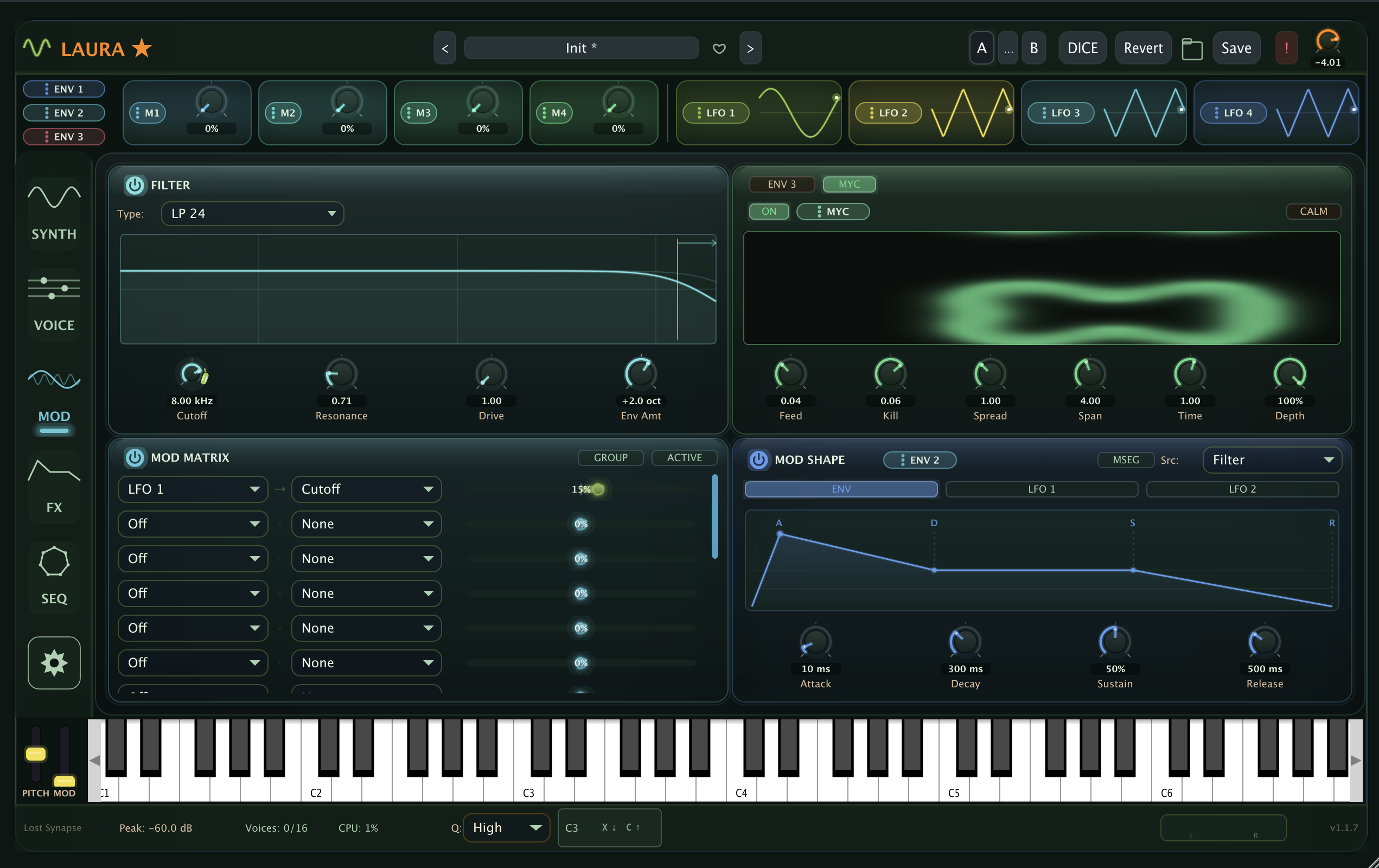
- Mycelium: a shared field the voices feed and read together. It's the first part of Laura where the notes in a chord affect each other. Play a tight chord and the voices grow into one another and the sound drifts around itself; play it wide and they stay apart. How you voice the chord is the control, and four new sources (Value, two gradients, and Flow) carry the field into the rest of the synth.
- Five factory presets built around Mycelium, so you can hear it without building a patch first: a slow drone whose voices drift apart under a held chord, a pad whose field pulses in time with the track, an expressive lead where leaning on one note feeds its bloom into the others, a generative texture, and a set of keys that leave a trail the next notes land in.
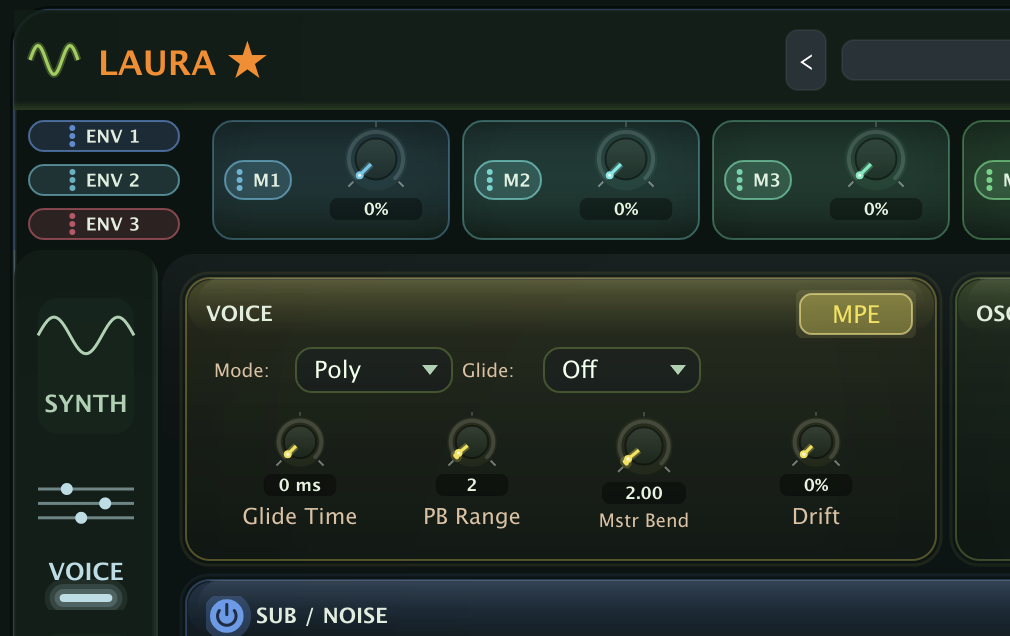
- MPE, per note. Any MPE controller works, a Seaboard, a LinnStrument, a Push, anything that puts each note on its own channel. Every note carries its own pitch bend, pressure, and slide, and each lands on the right voice. Bend one note of a chord and the others hold. An MPE switch lives in the gear menu and on the VOICE panel, it remembers itself across presets, and if your controller announces its own setup Laura follows it. It's per note on polyphonic patches, which is how you'll play MPE; the mono modes and the sequencer's own notes use the main wheel instead.
- Three new modulation sources you can use on any keyboard: Pressure (aftertouch), Mod Wheel, and Timbre (CC 74). Route them like you'd route an LFO.
- A live picture of the Mycelium field with a marker on each playing voice, so you can see where every note is reading. A Depth knob rides the whole field's influence at once, and a CALM button clears it when a long chord has filled it up.
- Two pitch bend ranges kept apart for MPE: a wide per-note range for finger slides, up to 48 semitones now, and a small master range for the main wheel.
- A round of fixes underneath. The new sources reach every modulation target now. A filter mode that could drop to silence in a rare case is fixed. Your existing patches sound exactly as they did.
Details
This is the release I've wanted to build since the start. Two big pieces. Mycelium, which is the first part of Laura where the notes in a chord actually affect each other, and per-note support for MPE controllers. A round of fixes sits underneath them.
Mycelium is a living field behind the synth. Every note you play drops a little chemistry into it, at a spot set by pitch and by how hard you played, and that chemistry spreads and grows the slow shifting patterns you get from a reaction-diffusion model. Each voice reads the field where it sits and turns what it finds into four new modulation sources. The part I like is that one note's chemistry spreads across into the spot where another note is reading, so the voices start to colour each other and you never routed a thing between them. Hold a tight chord and the three voices grow together and the chord drifts around itself over a few seconds. Play the same chord wide and it stays clean. How you voice it is the control. It's slow, and it's emergent, more like tending something than programming it, and it's the most alive Laura has felt to me.
On the MPE side, if you play a controller that puts each note on its own channel, a Seaboard, a LinnStrument, a Push in MPE mode, Laura now reads it per note. Each note's pitch bend, pressure, and slide belong to that note alone. Bend one note of a chord and the rest hold still. Lean on one and only it responds. There's an MPE switch in the gear menu and on the VOICE panel, it's the same setting in both places, and it stays on across presets and sessions because it's about your rig, not the patch. If your controller tells Laura how it's configured when it connects, Laura just follows. Pressure, Mod Wheel, and Timbre also show up as ordinary modulation sources, so even on a plain keyboard you can route aftertouch or the wheel to anything in the matrix. To be straight about the edges: per-note expression works on polyphonic patches, which is nearly all of how you'd play MPE. The mono and legato voice modes and the sequencer's own notes still use the main pitch wheel rather than per-note bends, so keep the patch in Poly when you want the expression.
Underneath, the fixes. The new expression and Mycelium sources now reach every modulation target, including the ones that update once per block like pitch and FM, instead of only the per-sample ones. A filter mode that could fall to silence in a corner case is fixed. The pitch bend range goes up to 48 semitones so MPE slides have somewhere to go. None of this touches your saved patches, and your license carries over as always.