Highlights
- Penrose, the sixteenth effect. It runs on the oldest trick in psychoacoustics: three voices ride the same slow lap, each fading in at the bottom and out at the top, so the handover happens where your ear cannot hear it. The motion never resets and never tops out. Hold a chord for as long as the build needs.
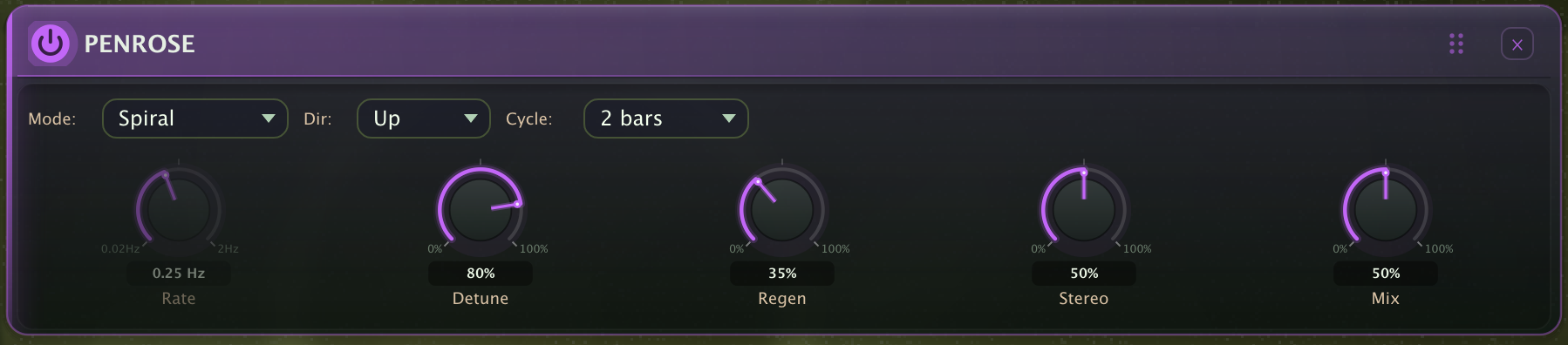
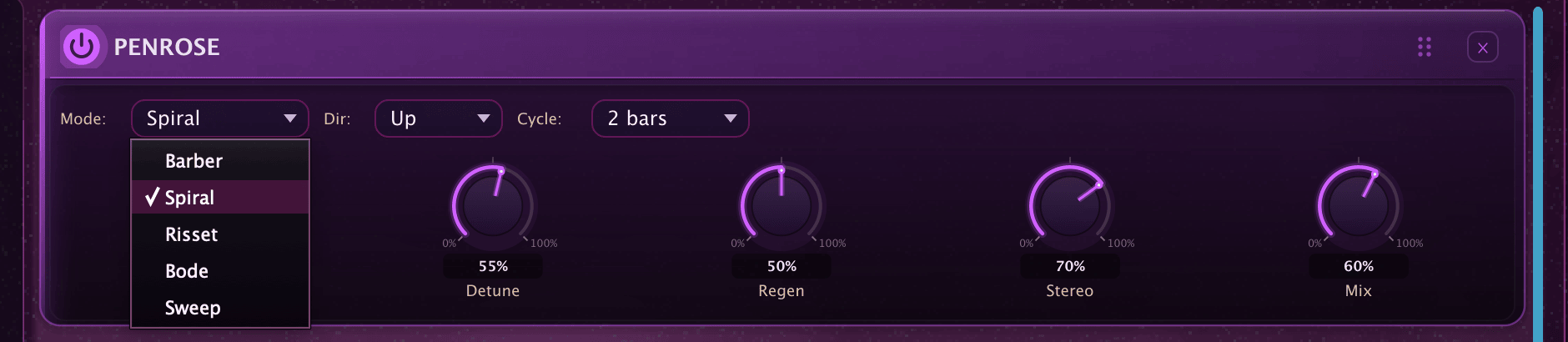
- Five modes, five kinds of endless. Barber is a barber-pole phaser, notches sailing upward forever. Spiral is the clean riser, tape style, so the laps comb like a chorus instead of fighting each other. Risset is a pulse that keeps accelerating. Bode is the inharmonic siren, metallic and mean. Sweep is a resonant peak climbing over whatever you feed it, an endless filter build with no automation lane.
- It locks to the bar. Pick a lap length from one bar to sixteen and a four bar rise lands with the drop instead of drifting past it. Direction flips climbing to sinking, which is the sound of dread rather than lift. Stereo throws the two channels out of step so the motion circles the room.
- Five presets that put it front and centre: a supersaw pad that climbs through a sixteen bar build, a 303 running its own filter sweep on loop, a rave gate that keeps speeding up, a drone that sinks forever, and a transition riser for the fader hand.
- The preset browser has a NEW chip now, so the latest patches are one click away instead of buried in a category. The library is at 298, all loudness matched.
- Penrose is in Laura FX as well, same device, same day, on any track you like.
- Your patches, packs, and license carry over exactly as before.
Details
Every riser I have ever printed had the same problem: it ends. You draw an automation lane, it climbs, it runs out of top, and then you either loop it and hear the seam or you stretch it and hear it slow down. So I built the thing that does not run out. Penrose is named after the staircase that keeps going up and comes back to where it started, and it works the way the Shepard tone works. Three voices ride one slow lap, each one sweeping bottom to top of its range while a gentle curve fades it in down low and out up high. When a voice reaches the ceiling it has already gone quiet, and a fresh one is already climbing out of the floor. Your ear stitches the three into one thing that rises and never lands. Set a lap to four bars, hold a chord, and it will still be rising when the break is over.
The first version of it sounded wrong and it took me a while to work out why. I had the three voices shifted by different fixed amounts, which sounds reasonable until you remember what two close pitches do when they overlap: they beat. Where the crossfade held two voices at equal volume, they were beating against each other at a few times a second, and a few times a second does not read as shimmer, it reads as a gate. The illusion was completely buried under a tremolo I never asked for. The fix was to make the voices share one pitch ratio at every instant instead of one fixed offset, so overlapping copies comb like a chorus rather than fight. That is Spiral, and it is the mode I reach for. The old inharmonic version survived as Bode, with the crossfades pulled much tighter so the voices mostly play alone; it is clangy and metallic and exactly right for a siren, which is a different job.
The other three modes take the same idea somewhere else. Barber sweeps a stack of notches instead of pitch, the barber-pole phaser you know from old records, except this one never turns around. Risset does it in the time domain: three tremolo layers in exact two to one rhythm, handing off so the pulse accelerates forever, which on a held minor stab is the drop that refuses to land. Sweep parks a resonant peak on your signal and walks it up the spectrum for as long as you leave it running, so a bassline plays its own build without you drawing a single line. Everything syncs to the host, everything runs the other way if you flip Direction, and the labels under the knobs change with the mode so you are reading what you are actually turning.
There are five new presets, one per mode, and each one is built to show the device off rather than hide it in a mix: Penrose Ascension for the pad that never arrives, Infinite Acid for the 303, Risset Stomper for the accelerating gate, Barber Undertow for the sinking drone, and Shepard Alarm for the riser you park over a break. To go with them the browser gained a NEW chip so you can find fresh patches without hunting, and one small correction elsewhere: the sequencer's Speed control now explains itself honestly, since it only applies when the shape is running free rather than following your tempo. Nothing about your saved patches, packs, or license changes.