Highlights
- Read mode is a new tab on each fractal oscillator, next to WARP. Wave is the oscillator as it has always been, with the brightness around the sampling circle as the waveform. It's the default, and every existing patch loads in Wave and sounds the same.
- Spectral reads the brightness as the level of each harmonic. Where the circle crosses the edge of the set you get a formant peak, and moving the circle moves the peaks. Amount, labelled Harmonics in this mode, spreads the circle over anything from 8 to 512 harmonics.
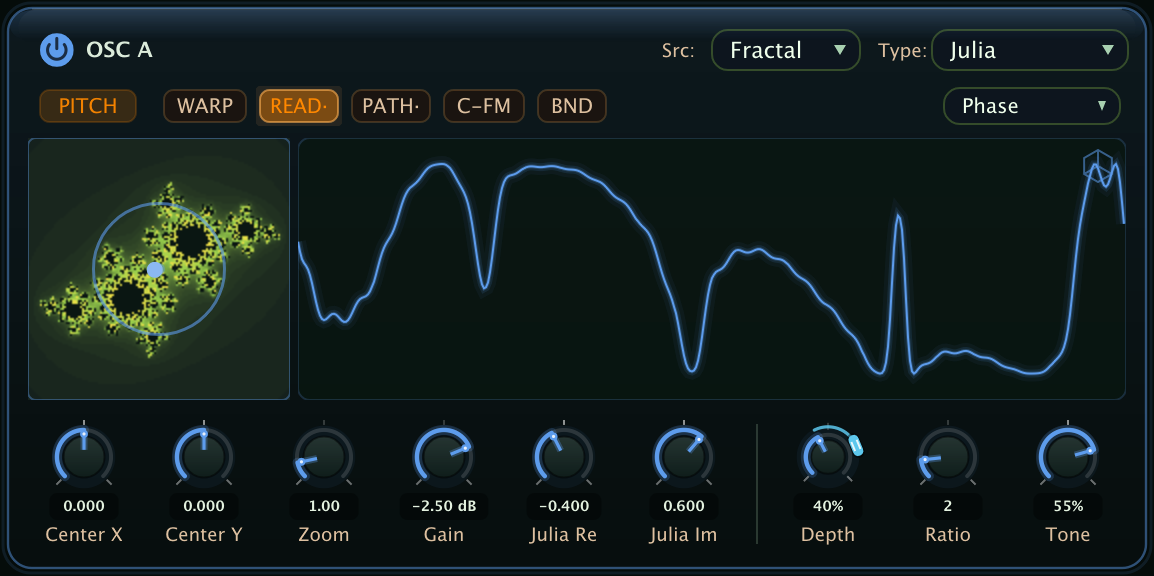
- Phase keeps a plain sine and bends its phase with a smoothed copy of the slice. Amount, labelled Depth here, goes from the bare sine to dense and metallic.
- Ratio runs the fractal 1 to 8 times per cycle of the sine, like the ratio on an FM operator. At 2 only the odd harmonics are left, which gives a hollow, reedy tone. Depth still sets the brightness at every ratio.
- Tone is one knob for the character of Phase. Left of centre rounds off the fractal's edges for a warmer, sweeter sound. Right of centre feeds the sound back into its own phase, like an FM operator's feedback. It turns brassy around halfway and gets close to a saw at the end.
- Read Amount and Read Tone are modulation targets, and their knobs show the routings on them. Like the fractal's centre and zoom, they take the instrument wide sources: LFOs, macros, the sequencer's path and the chaos attractor.
- Seven new presets: Seahorse Choir, Phase Tines, Bent Sine, Harmonic Weather, Formant Walker, Phase Pluck and Hollow Reed. Find them under the NEW chip in the browser. DICE also picks Spectral or Phase for fractal oscillators now and then.
- The target list on the sequencer's step lanes greys out the destinations a lane can't drive: the fractal's centre, zoom, boundary and read controls, and LFO rate and depth. A lane routed to one of them never did anything.
- Unison notes start at full strength. With Phase Random off, every copy in a stack starts at a fixed point in its cycle, and those points were the same whatever the count. At seven copies they cancelled most of a saw's harmonics, so a note started about 17 dB down and hollow, and six copies started almost 8 dB down. Each count now has its own start points, chosen so a note starts at the level and tone it settles into.
- Release tails no longer count as held notes when Laura shares out unison copies. Under the sustain pedal, a chord struck again every quarter second on a two second release thinned each new chord, to five copies, then four, then three. A note that steals a voice also gets the current unison count.
- In Poly mode a note with Sustain at 0 ends when its decay does. It used to keep its voice in silence until you let go, and once all 24 voices were busy, Laura cut an audible release tail before it touched one of those silent ones. Raising Sustain after such a note has died away no longer brings it back.
- Galaxy and Constellation balls take a voice for each strike instead of holding one for good, and the next strike picks up where the last one left off, so they sound the same with fewer voices. Lumen Cascade went from five voices on average to about one and a half.
- Fixed a rare fault that cut every sounding note at once. A voice could read a stretch of memory it had never cleared, and when that held garbage, the output guard did its job and silenced everything.
- Note names follow the on-screen keyboard, which calls middle C C3. The filter's Pivot and the sequencer's note names called the same key C4. Only the names changed, and every patch plays the same notes.
- The factory presets are levelled again, this time through the effects each one uses. Before, every preset was measured through the same default effects, so a preset with its own chain could sit several dB away from the rest. 234 presets moved, most of them down by about 3 dB.
- The window's animation follows the display's refresh, at a steady 60 frames a second instead of about 70, and the Mycelium view redraws only when the field changes on screen. On my M3 Pro, with the MYC page open and nothing playing, Laura went from about 51% of a core to about 30%.
- Smaller ones: the ENV 2 sweep on the MOD page dims when the filter, FILTER+ or ENV 2 is off, since none of it reaches the cutoff then. The sequencer header fits at the smallest window size. Key Follow keeps its transpose when you change sequencer mode.
- The manual has a new page on Read mode. Your patches, packs and license carry over. Laura FX moves to 1.7.6 alongside Laura.
Listen
Seahorse Choir · Spectral
A pad. The path drifts across the seahorse valley, and the formant peaks drift with it.
Hollow Reed · Phase, Ratio 2
A lead with only odd harmonics, over a quiet Seahorse Choir bed.
Phase Tines · Phase
Electric piano comping. The filter envelope does the strike, the fractal does the tine.
Formant Walker · Spectral
A lead at a low harmonic count, so the fractal's bright runs land where vowels would. Hold a note and the vowel moves.
Harmonic Weather · Spectral and Phase
Two oscillators reading two fractals two ways, with slow LFOs on both. Nothing in it repeats.
Details
This one came out of a conversation on Discord. Beatsbasteln pointed out that every fractal patch ended up with the same buzzy character, wherever you pointed the oscillator, and asked whether the fractal could be read some other way. He suggested two: as a spectrum, and as the thing that modulates a sine. Both are in, and he was right about why the old way sounds the way it does.
Escape values sit flat for most of the sampling circle and jump where it crosses the edge of the set. Played as a waveform, that's a cycle that is mostly a few sharp spikes, and a train of spikes buzzes whatever is in between them. Spectral and Phase take the same slice and use it for something that doesn't care about the jumps. In Spectral every harmonic gets a fixed starting phase, so when the fractal moves only the levels change, and two tables never cancel each other out while the oscillator crossfades from one to the next.
Ratio took two tries. The first version ran the whole fractal faster against the sine, and at ratio 4 its harmonics reached the 128th. Every one of those adds partials, and it came out muddy. Now the fractal gives up some of its detail as the ratio goes up, so its top harmonic stays in the same place. Depth decides how bright it is and Ratio decides how the partials are spaced. At 6 to 8 it gets close to classic two operator FM.
Feedback has to be solved for every sample of the table, because the output feeds its own phase. Laura does that at sixteen times the table's resolution and filters back down, so the bright end of a strong feedback patch doesn't fold back into the low harmonics. I checked the tables against an independent solve of the same equation, and they agree to about one part in a billion.
The unison fix is one I should have caught long ago. The copies in a stack are detuned by a few hertz at most, so for the first few tens of milliseconds of a note they haven't drifted apart yet, and their start points alone decide the sound. That's the attack, the part of a pluck you hear most. The old start points were sevenths of a cycle whatever the count. That spreads seven copies evenly around the cycle, which sounds tidy, and an even spread is exactly what cancels. If you own Laura this is a free update, as every update is.